


Views: 0 Author: Site Editor Publish Time: 2026-08-05 Origin: Site


A rechargeable hand lamp and a traditional flashlight both provide portable light, but they support different working habits. A flashlight is held and pointed toward a target. A hand lamp is commonly positioned beside or above the task so the user can work with both hands. That distinction affects beam shape, power planning, ergonomics, and suitable applications.
The better choice therefore depends on more than brightness. A technician repairing equipment at close range has different needs from someone walking through a dark outdoor area. This comparison looks at how rechargeable Hand Lamps and conventional battery-powered flashlights perform in real workshop, maintenance, inspection, and emergency situations.
Portable lights are often compared by maximum lumen output, yet output alone says little about usability. The first question should be where the light needs to go. If it must travel with the user's line of sight and illuminate objects several meters away, a flashlight may be appropriate. If it must remain aimed at a component while the user handles tools, a hand lamp usually has the stronger functional advantage.
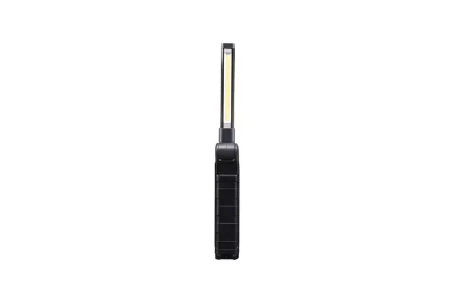
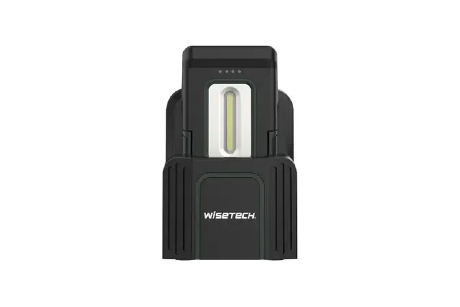
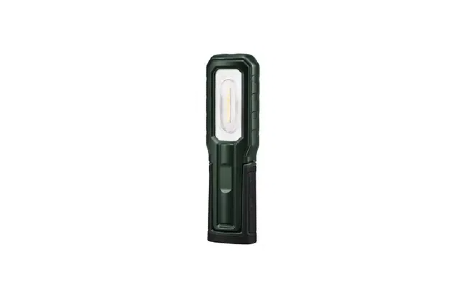
A rechargeable hand lamp is a close-range task light with an integrated battery and a body designed for holding, standing, hanging, or magnetic attachment. Many models combine a broad main light with a smaller focused light. Foldable brackets, rotating hooks, rear magnets, base magnets, and docking stations are common because the lamp is expected to become a temporary part of the workstation.
A traditional flashlight generally concentrates light into a forward beam. Its cylindrical or compact body is convenient to carry in a pocket, bag, vehicle, or emergency kit. Many models use replaceable alkaline or primary lithium batteries, although rechargeable flashlights are also widely available. For this comparison, the traditional flashlight refers mainly to the familiar handheld search light powered by replaceable cells.
 |  |  |
The most visible difference is the shape of the beam. Hand lamps typically provide a wide field of light intended to illuminate a work surface. Flashlights usually provide a more concentrated beam intended to reach farther. Neither pattern is universally superior; each is optimized for a different visual task.
When repairing a brake assembly, reading a control panel, checking wiring, or working beneath a sink, the user needs to see the component and the surrounding area. A broad beam reduces the need to sweep the light repeatedly from side to side. It also helps the worker see where tools, fasteners, and cables are positioned relative to the main task.
A flashlight can direct more of its output into a smaller area. This is helpful when checking a distant shelf, walking through an unlit building, identifying an object outdoors, or looking along a long passage. A focused beam can also reach into a narrow opening, although many hand lamps address this need by adding a top torch light alongside the main area light.
A flashlight performs well while it is held. The difficulty begins when the user needs both hands. It may be placed on a bench, held under the arm, balanced against a toolbox, or passed to another person. These improvised solutions work briefly, but the beam may roll away, point into the user's eyes, or shift as soon as the supporting surface is disturbed.
A hand lamp is built to avoid that problem. A magnetic base can attach to a steel cabinet or vehicle panel. A rotating hook can suspend the lamp from a pipe, cable, hood, shelf, or frame. A foldable stand can hold the light at a selected angle on a flat surface. This positioning flexibility often makes a hand lamp more productive even when its maximum output is lower than that of a flashlight.
A rechargeable hand lamp can be charged from a USB connection, Type-C cable, dedicated base, or compatible charging station, depending on the design. For frequent users, this removes the repeated purchase and disposal of primary batteries. A battery-level indicator also makes the remaining power visible, allowing the user to recharge before a long task rather than discovering a weak battery halfway through it.
The main limitation is that the lamp must be managed as part of a charging routine. If it is left uncharged, the user cannot restore full runtime instantly unless a second lamp or compatible spare battery is available. Battery capacity, charging time, low-temperature performance, and long-term cycle life therefore matter to professional users.
A flashlight using standard replaceable cells can return to service immediately when fresh batteries are available. This is useful for emergency kits, remote locations, infrequent use, or situations where charging power may be unavailable. Primary lithium batteries can also provide long storage life in suitable applications.
The disadvantage appears when the light is used daily. Battery cost accumulates, spare cells must be stored and rotated, and performance may decline gradually without a clear indication. In a busy workshop, users may also mix old and new batteries or leave depleted cells in the tool, creating unnecessary maintenance and waste.
A flashlight can be comfortable for short searches because its grip aligns naturally with the direction of the beam. For prolonged close-range work, however, continuously holding and aiming it occupies one hand and may create wrist fatigue. A hand lamp can be held like a work tool when necessary, but its real ergonomic benefit comes from being placed independently.
Both product types are available in rugged versions, so category alone does not determine durability. Buyers should examine housing material, impact resistance, dust and water protection, lens construction, charging-port protection, operating temperature, and the stability of hinges or hooks. A workshop light is likely to be dropped, exposed to dust, placed near fluids, and handled repeatedly.
The rechargeable hand lamp is usually the better primary tool. It can illuminate an engine bay, wheel area, machine panel, or underside while the technician uses both hands. Magnetic attachment and hooks reduce the need for a second person. A top light can still provide focused inspection when the main area light is not suitable.
The traditional flashlight generally performs better when the user is moving and needs to direct light ahead. Security checks, outdoor walking, locating objects across a yard, and emergency navigation all benefit from a concentrated beam and a body that is easy to carry continuously.
The answer is less clear. A flashlight with long-storage batteries can be dependable when used only occasionally. A rechargeable hand lamp offers better hands-free lighting for changing a tire, checking an engine, or managing a power outage, but it needs periodic charging. Some users keep both: a flashlight for navigation and a hand lamp for stationary work.
Choose a rechargeable hand lamp when the work is close to the body, both hands are needed, the light must remain aimed for several minutes, and suitable mounting surfaces are available. It is especially practical for automotive repair, machine maintenance, inspection, assembly, plumbing, HVAC service, and routine facility work.
It is also a strong choice when the organization wants to reduce disposable-battery use and create a standard charging location. A docking station can keep shared lamps visible and ready. Adjustable brightness can balance output and runtime, while a battery indicator helps teams manage tools across a shift.
Choose a flashlight when portability in motion, long-distance beam reach, simple storage, and immediate battery replacement are the main priorities. It suits security personnel, outdoor users, emergency navigation, occasional household use, and any task in which the user naturally holds the light while moving.
A flashlight may also be preferable where magnetic attachment is unsafe or ineffective and there is no suitable place to hang or stand a lamp. Its straightforward form is easy to keep in a pocket or belt holder, and standardized batteries can be useful in remote service operations with established battery supplies.
The comparison does not have to end with one product replacing the other. In many workshops, a flashlight helps locate the problem or move through an unlit area, and a hand lamp is then positioned for diagnosis and repair. When only one product is selected, follow the dominant use case: close-range, stationary work favors the hand lamp, while mobile, distance-oriented viewing favors the flashlight.
Before purchasing, compare useful beam pattern, low and high output modes, operating time, charging method, battery indicator, grip, weight, impact protection, water and dust resistance, mounting options, and after-sales support. Do not rely only on the highest lumen figure printed on the package. A light that can be positioned correctly and remain available throughout the job will usually deliver more practical value than a brighter product that is awkward to use.
For brands, importers, and professional lighting distributors evaluating rechargeable hand lamp programs, XIAMEN WISETECH LIGHTING develops and manufactures mobile work-light products for overseas markets. Its range includes compact inspection lamps, magnetic and hook-mounted designs, broad and focused light combinations, and different charging configurations for workshop, automotive, maintenance, and private-label requirements.


