


Views: 0 Author: Site Editor Publish Time: 2026-08-31 Origin: Site


LEDs are inherently Direct Current (DC) devices at their core. Powering them using Alternating Current (AC) on a mobile job site introduces unnecessary conversion steps. You face extra energy loss and introduce major hardware vulnerabilities. As off-grid solar and battery ecosystems rapidly evolve, the industry is shifting. Construction crews now steadily move away from heavy, generator-dependent AC lighting setups.
For procurement managers and job site supervisors, transitioning to DC Work Lights improves operational efficiency. It directly enhances worker safety through strict low-voltage compliance. By removing AC dependencies, job sites run smoother and much safer. However, you must properly manage the physical limitations of DC power distribution.
We will explore how skipping the AC conversion drastically improves reliability. You will learn deployment strategies for modern portable lighting systems. We will also detail specific environments where native direct current lighting strictly outperforms legacy alternating current units.
Native DC LED systems eliminate the heat and energy loss associated with AC-to-DC conversion drivers.
Low-voltage DC lighting significantly reduces electrical shock risks in wet or highly conductive work environments.
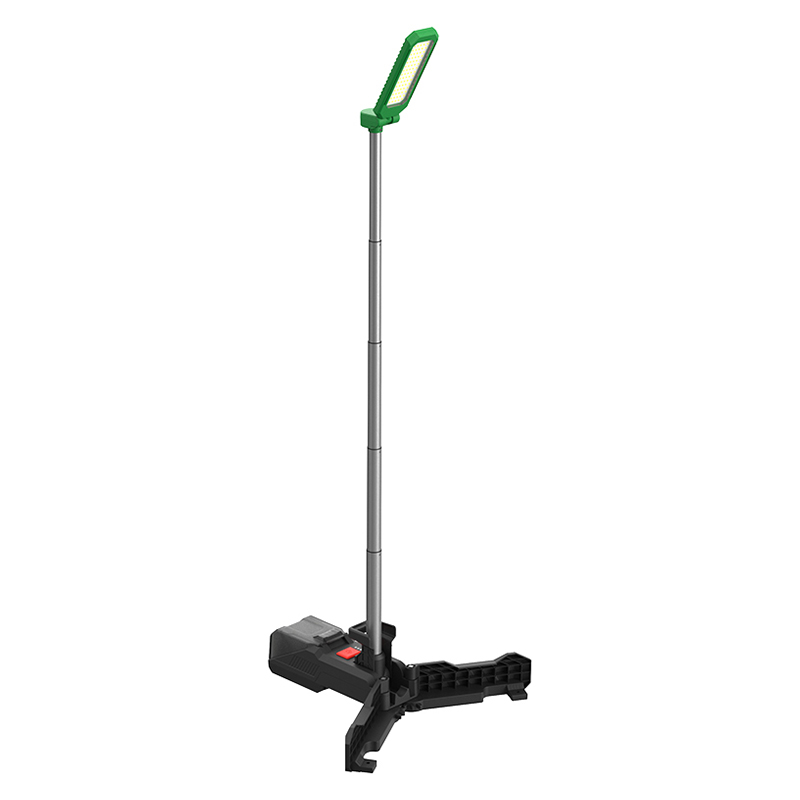
Stand-alone solutions, such as the battery tripod work light, offer rapid deployment without the trip hazards or setup time of AC extension cords.
Implementing DC lighting requires careful attention to wire gauge and voltage drop over long distances, making it best suited for localized or portable applications.
LEDs natively require direct current to emit light. Every time you plug an AC LED fixture into a wall or a generator, it relies on an internal driver. This driver converts the high-voltage AC into low-voltage DC. This required conversion process is inherently inefficient.
Standard drivers typically waste 10% to 20% of the input energy. The system dissipates this wasted energy entirely as heat. This added thermal load forces the fixture to work harder. Ultimately, you pay for electricity or generator fuel to create unwanted heat instead of usable lumens. Removing this driver solves the primary thermal bottleneck.
Job sites increasingly rely on mobile battery banks or off-grid solar setups. In these scenarios, using AC fixtures creates a severe double penalty. Your main battery supplies DC power. Next, a large inverter steps it up to AC power. Finally, the light fixture’s driver drops it back to DC. Each stage bleeds valuable energy.
Inverters also suffer from parasitic drain. They consume battery power simply by remaining powered on. This constant standby draw drains batteries quickly, even if you dim the lights or switch them off temporarily.
Manufacturers often praise LEDs for lasting over 50,000 hours. However, the diodes rarely fail first in real-world scenarios. The AC-to-DC driver remains the weakest link in any traditional fixture. Intense thermal stress slowly degrades the internal capacitors of the driver circuit. When the AC driver burns out, the entire fixture goes dark. By removing the alternating current conversion step entirely, you eliminate the most common hardware vulnerability.
Direct battery-to-LED connections remove the power conversion bottleneck entirely. Native DC lighting systems route electricity straight from the source to the diode matrix. This 1-to-1 power delivery maximizes your lumen-per-watt output.
Every amp drawn from your battery translates directly into illumination. You extract the absolute maximum runtime from your available power source. This efficiency is critical during overnight operations where recharging batteries is not a viable option.
Removing the bulky AC driver from the housing provides distinct physical benefits. Native direct current fixtures operate significantly cooler. Without a hot driver generating excess heat inside the casing, the external heat sinks handle only the thermal output of the diodes themselves. Cooler diodes experience far less lumen depreciation over time. Better thermal management extends the effective operational lifespan of your lighting equipment.
High-voltage AC lines pose severe shock hazards on wet or highly conductive construction sites. Industrial safety bodies like OSHA strictly regulate high-voltage usage in hazardous, damp, or confined spaces. Low-voltage standards naturally align with strict safety protocols.
Most commercial-grade DC lighting circuits operate safely at 12V, 24V, or 48V standards. These low-voltage thresholds drastically reduce fatal electrocution risks. Workers can safely deploy these compliant lights inside metal utility tanks, flooded basements, or exposed outdoor trenches.
We must maintain a realistic perspective when evaluating worksite power. DC power is not a magical solution for every single lighting requirement. The physics of electrical distribution impose hard physical limitations that you must respect.
The primary drawback of direct current is severe line loss over extended distances. When you push low-voltage electricity through long cables, electrical resistance causes a noticeable voltage drop. If you try to daisy-chain lights over 100 feet from a central power bank, the farthest lights will visibly dim.
Overcoming this requires thicker, highly conductive wire. Lower AWG (American Wire Gauge) cables are quite expensive and remarkably heavy. Consequently, centralized low-voltage distribution over massive, sprawling sites becomes impractical.
Because of these cable limitations, direct current shines brightest in specific, localized environments. It perfectly suits areas where the power source sits close to the light head.
Consider these ideal deployment scenarios for direct current systems:
Localized Rapid-Deployment Zones: Areas requiring intense, temporary illumination instantly without stringing centralized cables.
Solar-Integrated Mobile Light Towers: Standalone units where heavy batteries sit mere feet from the overhead light fixtures.
Vehicle-Powered Auxiliary Lighting: Equipment mounted directly on utility trucks, RVs, and emergency response vehicles using onboard 12V alternators.
AC vs. DC Performance Comparison Chart
Performance Metric | AC Lighting Systems | DC Lighting Systems |
|---|---|---|
Energy Conversion Loss | 10% - 20% driver loss | Virtually 0% (Direct connection) |
Thermal Output | High (Diode + Driver heat) | Low (Diode heat only) |
Electrocution Risk | High (120V/240V fatal risk) | Low (12V/24V safe thresholds) |
Long Distance Wiring | Excellent (Minimal line loss) | Poor (Severe voltage drop) |
Traditional AC setups require heavy diesel generators and thick, 50-foot extension cords running across active footpaths. These sprawling cords introduce serious trip hazards. Cordless battery setups resolve this hazard instantly.
A well-designed Battery Tripod Work Light eliminates ground cables entirely. Workers can set it up wherever it is needed in seconds. Nobody has to navigate a dangerous maze of wires while carrying heavy building materials.
Modern job sites run heavily on standardized power tool batteries. Many leading portable lights now seamlessly integrate into these existing ecosystems. They feature smart adapters designed specifically for 18V or 20V battery packs.
This cross-platform compatibility provides a massive operational advantage. Crews do not need to manage separate, proprietary chargers. They simply pull a standard battery off their drill and snap it into their floodlight. This keeps the site uniform and simplifies equipment management.
Labor hours dictate construction project budgets. Untangling frozen cords and repeatedly pulling generator cords wastes valuable productive time. A cordless tripod unit deploys and retracts in less than thirty seconds.
As the worksite evolves throughout the day, workers can instantly reposition the lighting. This rapid scalability heavily improves site productivity. It eliminates the friction of moving traditional wired light towers.
Mobility matters immensely on active sites. When evaluating a fixture, always compare the total brightness against its physical weight. A massive, heavy fixture requires more physical effort to mount and transport daily.
You should prioritize a high lumen-to-weight ratio. Look for modern, lightweight housing designs offering high lumen output. This ensures you maximize true portability without sacrificing illumination coverage.
Worksite power sources vary widely. The best industrial fixtures feature wide-voltage input ranges. Circuits supporting broad 10V to 30V inputs provide enormous flexibility.
This capability allows you to run the light off standard 18V tool batteries on Tuesday, and plug it into a 12V automotive circuit on Wednesday. You get full utility without frying the internal circuit boards.
Harsh work environments expose gear to severe dust and driving moisture. You must evaluate the hardware ingress protection rating based on your expected environmental exposure.
Ingress Protection (IP) Rating Guide
IP Rating | Dust Protection Level | Water Protection Level | Best Use Case |
|---|---|---|---|
IP54 | Dust protected | Splashing water | Indoor jobs, light workshops |
IP65 | Dust tight | Water jets (rain) | General outdoor construction |
IP67 | Dust tight | Temporary submersion | Marine, heavy trenching, extreme weather |
High-performance LEDs generate localized heat during operation. Running them continuously in high-temperature summer environments threatens diode longevity. Smart thermal throttling protects your valuable equipment.
Advise your procurement team to check if the fixture includes automatic dimming logic. If the internal housing overheats, smart circuits slightly reduce power automatically. This protects the delicate diodes from permanent damage while keeping the lights on.
The shift toward low-voltage lighting platforms represents a return to the native physics of LED technology. This transition yields definitively better energy efficiency, enhanced worker safety, and much greater operational flexibility.
We strongly recommend transitioning all localized, mobile task lighting to battery-based DC ecosystems immediately. You should reserve heavy AC generators and bulky cabling exclusively for massive, grid-tied stadium lighting needs.
Start taking action today. Audit your current generator fuel consumption and calculate your setup labor hours. Evaluate these metrics by running a pilot test with a commercial-grade portable battery tripod on your very next project.
A: Yes. The actual brightness depends entirely on the LED diode capability and the wattage applied, not the electrical current type. A 50W DC fixture produces the exact same lumen output as a 50W AC fixture. The main limitation is simply your battery capacity for extended runtimes, rather than any restriction on the diode itself.
A: You can, but you will need a dedicated step-down converter or an AC-to-DC power supply. Doing this reintroduces the very conversion losses you are trying to avoid. It completely defeats the direct-connection efficiency advantage of the platform.
A: It depends heavily on system voltage and wire gauge (AWG). For standard 12V systems, pushing power beyond 30 to 50 feet causes a severe voltage drop, making lights dim. Upgrading to a 24V or 48V system allows longer runs. You must always use thicker, lower-AWG cables for distances exceeding 100 feet.
A: No. Direct current provides a flat, constant flow of electricity. Alternating current relies on an alternating sine wave, which naturally causes rapid micro-flickering. DC lights offer true zero-flicker illumination. This prevents the dangerous stroboscopic effect when operating near fast-rotating machinery like saws and lathes.


