


Views: 0 Author: Site Editor Publish Time: 2026-08-24 Origin: Site


Battery-powered tools dominate modern job sites today. They offer incredible convenience for quick, temporary tasks. However, uninterrupted, high-lumen output strictly requires continuous AC power. Dead batteries simply halt productivity during critical construction phases. Selecting the wrong lighting creates immediate problems for your entire crew. You risk poor visibility. This directly leads to severe quality defects in drywall texturing or custom paint finishes. Inadequate illumination also introduces severe safety hazards, including hidden trip risks or accidental heat burns. Furthermore, you may face strict compliance penalties if your gear fails safety inspections. This guide gives you a realistic, spec-driven framework. You will learn to evaluate and select industrial-grade lighting tailored precisely to your daily operational needs. We cover essential metrics matching specific site requirements, strict safety standards, and overall project scale. You will discover how to keep your crew perfectly safe and completely productive through every single shift.
AC work lights deliver unmatched, continuous lumen output essential for multi-shift or large-scale projects.
Evaluation must go beyond raw lumens to include Color Rendering Index (CRI), IP/IK durability ratings, and heat dissipation.
Form factor dictates functionality; a portable AC work light must balance mobility with a stable, secure base.
OSHA compliance and daisy-chain capabilities are critical factors for industrial and commercial job sites.
Construction projects operate on tight, unforgiving deadlines. Equipment reliability directly impacts your project timeline. While cordless technology improves yearly, certain tasks demand absolute, unwavering illumination.
Cordless equipment works beautifully for mobile drilling or occasional cutting. Continuous lighting demands something entirely different. You cannot afford fading lumens during an overnight concrete curing process. Large-scale drywall finishing requires absolute shadow-free consistency across massive wall expanses. If a battery dies halfway through a skim coat, the mud dries unevenly while workers fetch fresh power packs. Winter construction presents another massive challenge. Cold temperatures drain lithium batteries exceptionally fast. Winter builds often pair temporary heating equipment alongside heavy illumination. Multi-day commercial builds need reliable fixtures running indefinitely. In these demanding scenarios, industrial-grade AC Work Lights deliver the stamina required. They provide unblinking, consistent voltage regardless of the ambient temperature or task duration.
Continuous power strictly eliminates frustrating battery management headaches. Your crew stops wasting valuable time swapping out depleted packs. You avoid charging downtime completely. Managing twenty batteries across a site requires a dedicated charging station. This station pulls resources and requires constant monitoring. Lithium batteries also degrade heavily over repeated charge cycles. Plug-in models bypass this chemical degradation entirely. The ratio of actual work hours to equipment maintenance heavily favors corded units. Productivity remains completely stable from early morning until midnight. Workers stay focused purely on their designated trade tasks.
Every equipment solution involves specific trade-offs. Corded models introduce physical cables into dynamic, fast-moving workspaces. This creates genuine cord management challenges. Loose cables present serious potential trip hazards. You must plan your cable routing carefully. Choosing the right fixture mitigates these physical risks through smart, intentional design. Proper cord wraps keep excess cable secured securely to the unit body. Highly visible, brightly colored cabling alerts workers to the power path. Strategic placement near power drops reduces unnecessary cable sprawling across walking paths. By acknowledging these risks, you deploy continuous power safely.
Raw brightness means nothing if you direct it poorly. You must evaluate usable light spread and durability metrics before purchasing.
Professionals divide lighting into two distinct categories. You must match the lumen output to your specific spatial requirements.
Task Lighting (1,000–3,000 lumens): Perfect for localized, up-close tasks. Use them for plumbing repairs under dark sinks. They excel during detailed electrical panel wiring.
Area Lighting (5,000–10,000+ lumens): Essential for illuminating entire rooms or outdoor areas. They flood framing stages or massive concrete pours efficiently.
Beam angle dictates your actual light distribution. Wide diffusion heavily prevents harsh, distracting shadows. It dramatically reduces blinding glare. This ensures much better eye safety for workers passing near the fixture.
Lighting Type | Lumen Range | Ideal Application | Recommended Beam Angle | Key Benefit |
|---|---|---|---|---|
Task Lighting | 1,000 - 3,000 | Confined spaces, electrical work, plumbing | 60 - 90 degrees | Reduces eye strain for up-close precision tasks |
Area Lighting | 5,000 - 10,000+ | Drywall finishing, framing, concrete pours | 120 - 360 degrees | Eliminates dark corners across large room volumes |
Lighting directly dictates finished work quality. Professional tradesmen need highly accurate color representation. We measure this accuracy using the Color Rendering Index (CRI). A CRI score of 80+ is universally recommended for professional sites.
Electricians absolutely depend on high CRI to differentiate subtle wire color coding. Confusing a red wire for a brown wire causes catastrophic electrical failures. Painters need high CRI for absolute finish accuracy. A low CRI light makes a perfectly matched paint job look severely flawed. Color temperature should sit steadily between 4000K and 5000K. This specific range mimics natural daylight beautifully. It keeps your workers alert while revealing surface imperfections clearly.
Construction environments destroy fragile equipment incredibly fast. You must rigorously verify IP and IK ratings before deploying fixtures.
IP Ratings: This metric measures water and dust resistance. The first number indicates solid ingress protection. The second number indicates liquid ingress protection. We strongly recommend an IP65 minimum for outdoor or wet sites. This completely stops total dust ingress. It safely blocks low-pressure water jets from any direction.
IK Ratings (Impact Protection): This metric measures kinetic impact protection. Tools drop constantly. Scaffolding shifts unexpectedly. You must choose IK07 or higher. An IK07 rating survives a 2-joule impact. This equals a 500-gram heavy tool dropping directly onto the lens from 40 centimeters.
Rating Type | Recommended Minimum | Practical Meaning on Job Site |
|---|---|---|
IP (Ingress Protection) | IP65 | Totally dust-tight. Survives direct rain and hose spray. |
IK (Impact Protection) | IK07 | Lens will not shatter if knocked off a standard ladder. |
IK (Extreme Impact) | IK08+ | Survives severe strikes from swinging scaffolding pipes. |
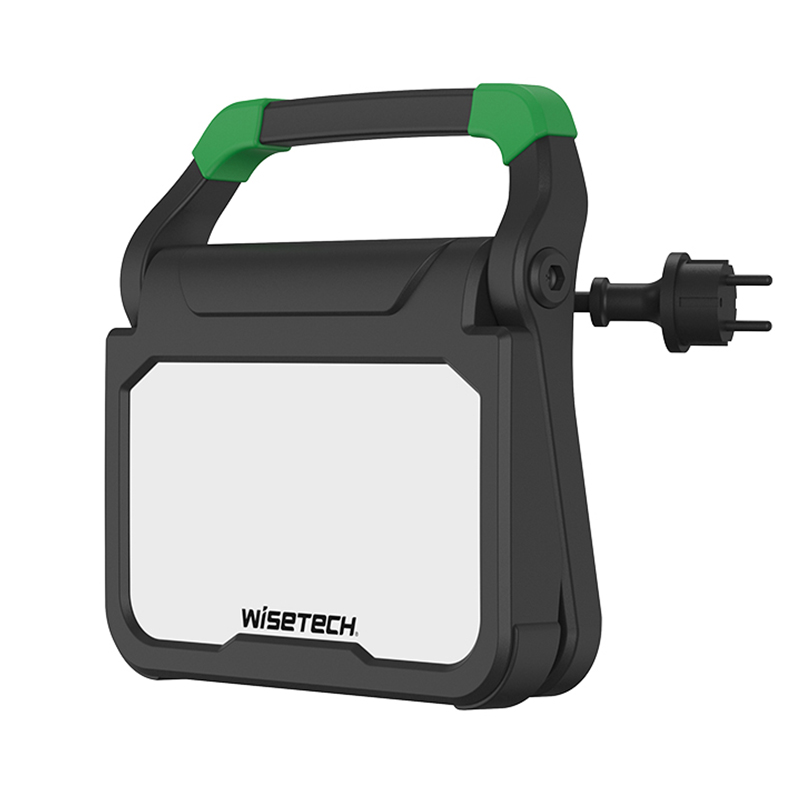
Equipment form factor dictates exactly how you deploy illumination. A well-designed Portable AC Work Light must balance ultimate mobility against steadfast stability.
These units handle wide-area illumination perfectly. You deploy them initially for rough framing or large concrete pouring. Stability remains absolutely critical here. Look closely for wide leg stances. Wind easily knocks over narrow tripods, causing unwanted damage. Height adjustability allows you to cast light downward. Top-down lighting effectively mimics the sun. This minimizes blinding eye-level glare when workers cross the room.
Floor models remain highly versatile across all trades. They handle low-angle tasks brilliantly. Baseboard trim installation requires powerful floor-level light. Focus on securing units featuring sturdy anti-slip bases. Rubberized feet prevent scratching newly finished floors. Adjustable tilt brackets let you aim beams precisely where needed. Low-profile designs actively prevent accidental tipping inside tight, high-traffic hallways.
Confined spaces demand creative mounting solutions. HVAC technicians and plumbers navigate cramped drop ceilings constantly. Here, magnetic options truly shine. Emphasize fixtures possessing strong neodymium magnets. These grip steel I-beams or ductwork securely. Ensure the magnets feature rubber coatings. This prevents scratching sensitive painted metal surfaces. Integrated carabiners or heavy-duty hooks allow secure hanging from overhead pipes. This keeps the floor completely clear of trip hazards.
A true portable AC fixture must incorporate ergonomic carrying handles. Workers refuse to move clunky, uncomfortable equipment. Integrated cord wraps physically prevent tangled messes during transport. Sensible weight distribution guarantees one single worker can relocate the unit quickly. Efficient relocation keeps the project moving smoothly between distinct work zones.
Site safety remains your ultimate priority. Modern lighting technology solves many legacy safety issues inherently.
Legacy halogen models dominated sites in past decades. Modern LED technology renders them completely obsolete. Halogen bulbs generate massive, dangerous heat. They easily reach temperatures exceeding 500 degrees Fahrenheit. This creates severe, instantaneous burn hazards for your crew. Halogens easily ignite nearby sawdust or plastic sheeting, causing devastating site fires. LEDs eliminate this danger entirely. They remain relatively cool to the touch even after hours of continuous operation. Furthermore, their extreme energy efficiency ensures a significantly lower amp draw.
Massive sites require extensive lighting arrays. Daisy-chaining simplifies this logistical nightmare immensely.
Integrated Receptacles: Premium fixtures include built-in AC outlets directly on the housing. These let you string multiple lights together on one continuous run. You only need one single power outlet at the source.
Amp Load Limits: You must observe safety caveats very closely. Highlight maximum wattage and amp limits always. Most temporary job site breakers handle 15 or 20 amps safely. Exceeding these exact limits causes blown breakers on shared site circuits. Plunging a site into sudden darkness creates an immediate safety crisis.
Safety inspectors look closely at temporary lighting arrays. Grounded plugs are strictly non-negotiable for job site compliance. Cords must feature heavy-duty industrial ratings. Look for SJTW designations printed on the cable. This means the cord resists heavy abrasion, resists oil, and withstands harsh weather. Lenses should utilize shatter-resistant polycarbonate materials exclusively. Traditional glass lenses shatter upon impact. Broken glass on a job site triggers immediate safety violations and halts production.
Selecting the perfect unit requires methodical logic. Use these highly practical steps to evaluate your choices.
Indoor finishing needs differ vastly from outdoor rough-ins. Map your environment carefully before buying. Indoor tasks heavily prioritize high CRI values and extreme glare reduction. Your drywallers need smooth, raking light. Outdoor rough-ins demand extreme physical durability. You need strict IP65 ratings to combat mud and heavy rain. Outdoor work requires massive, volumetric lumen output to fill empty night skies safely.
Assess your generator capacity very early in the planning phase. Map out temporary power pole limits accurately on site. You share temporary power with hungry tools like table saws and heavy air compressors. Lighting amp draws must remain manageable. Calculate your exact loads. If a circuit provides 20 amps, and your saw draws 15 amps, you only have 5 amps remaining. High-efficiency LED work lights pulling merely 0.5 amps each allow you to run up to 10 lights on that remaining capacity safely.
We highly recommend standardizing a single lighting ecosystem. Choosing one reliable, professional brand for site-wide lighting massively simplifies cord management. It streamlines maintenance and makes daisy-chaining infinitely safer. Your electrical cords match. Your daisy-chain amp limits remain totally uniform. Your crew quickly learns one single setup protocol. This standardization vastly accelerates daily deployment and breakdown times.
The right temporary lighting bridges the crucial gap between absolute site safety and high operational efficiency. Powerful, continuous illumination keeps your projects moving forward reliably. Fading batteries should never dictate your daily workflow. We strongly encourage buyers to prioritize absolute physical durability. Focus heavily on necessary IP and IK ratings first. Match specific task requirements like CRI and distinct form factors carefully. Avoid simply chasing the highest raw lumen count available. Better light distribution always beats harsh, blinding brightness. Equip your professional crews properly, and they will deliver superior building results safely.
A: No. You can only daisy-chain models featuring integrated, correctly rated receptacles. Always calculate your total amp load first. Exceeding the temporary circuit's maximum capacity will quickly blow breakers and halt work entirely.
A: Work lights prioritize rugged portability and extreme impact resistance. They feature high IK ratings, ergonomic carrying handles, and corded mobility. Standard floodlights are typically designed for permanent, stationary mounting on completed buildings.
A: You need a minimum IP65 rating. This specific level entirely protects the internal electrical components against total dust ingress. It also safely blocks low-pressure water jets arriving from any direction.
A: Halogens face a rapid, widespread industry phase-out. They pose extreme heat risks, causing severe accidental burns and rapid fire hazards. Modern LEDs are now the definitive industry standard for strict safety and compliance.


