


Views: 0 Author: Site Editor Publish Time: 2026-08-28 Origin: Site


Job site lighting is no longer just a utility. It acts as a critical variable in operational safety, energy efficiency, and workflow continuity. Traditional Alternating Current (AC) lighting relies heavily on established grid infrastructure. This reliance introduces severe mobility constraints and strict safety limits. Conversely, Direct Current (DC) lighting offers exceptional agility. It pairs natively with renewable energy sources and significantly lowers high-voltage risks. However, you must carefully manage battery stations or micro-grids to keep operations running smoothly.
We developed this article to provide a rigid, application-based framework. It helps project managers and facility engineers evaluate different lighting architectures. You will learn which setup aligns best with your specific environmental and operational demands. We will explore safety standards, hardware compatibility, and deployment strategies. This ensures you can illuminate your job site effectively while mitigating risk.
DC Work Lights eliminate conversion losses, maximize safety in wet or confined environments, and offer superior mobility for dynamic job sites.
AC Work Lights remain the standard for static, permanent installations where continuous, high-lumen output is required without the logistical overhead of battery management.
Adopting a Multi Battery Work Light ecosystem bridges the gap, allowing users to leverage existing cordless tool platforms for extended, flexible DC lighting.
The final decision hinges on three core metrics: infrastructure availability, environmental hazard levels, and the demand for portability versus permanent runtime.
Electrical power dictates how commercial lighting performs in demanding environments. You must understand how alternating current functions on traditional job sites. Most established projects pull 120V or 240V AC directly from the grid. Heavy-duty generators also supply this high-voltage power. Standard AC LED fixtures rely on internal drivers and rectifiers. These internal components transform incoming AC into direct current. LEDs inherently require direct current to illuminate their diodes. This mandatory conversion step causes friction inside the hardware.
This reality brings us to the distinct advantage of direct current. When you deploy native DC Work Lights, they operate without these intermediary conversions. Removing the AC-to-DC rectification step directly at the fixture level yields major benefits. You significantly reduce heat generation inside the casing. Lower internal temperatures directly reduce component failure risks. The diodes receive pure, uninterrupted power. This creates a highly stable illumination source.
We now see a massive convergence of these technologies across industrial sectors. Modern sites increasingly rely on smart, hybrid setups. Contractors run commercial AC power to the site perimeter to handle heavy machinery. Meanwhile, temporary or mobile lighting operates entirely on standardized DC battery platforms. This convergence provides incredible versatility. Crews enjoy the infinite runtime of grid power alongside the untethered agility of localized battery arrays.
Certain environments demand stringent safety protocols. High-hazard and confined spaces sit at the very top of this list. Low-voltage DC is mandatory or heavily preferred in wet and damp environments. Think about marine engine rooms, underground utilities, or fresh concrete pours. You must mitigate shock hazards at all costs. Direct current inherently runs at lower voltages. This limits the risk of fatal electrical discharge if a worker accidentally compromises a cable or drops a fixture into standing water.
Off-grid integration offers another massive advantage. Green building initiatives increasingly utilize temporary solar arrays to power construction phases. Solar panels naturally produce direct current. Connecting these arrays directly to DC fixtures bypasses the inverter entirely. You avoid the standard 10% to 15% energy loss typically caused by inverter conversions. This makes your temporary site micro-grid remarkably efficient.
We must also address the cordless mobility requirement. Extension cords create notorious trip hazards. They tangle, fray, and obstruct high-traffic construction zones. Dynamic construction phases require constant movement. Battery-powered DC units eliminate these trailing cables entirely. Workers can instantly reposition illumination as the task evolves. They spend zero time managing cable runs.
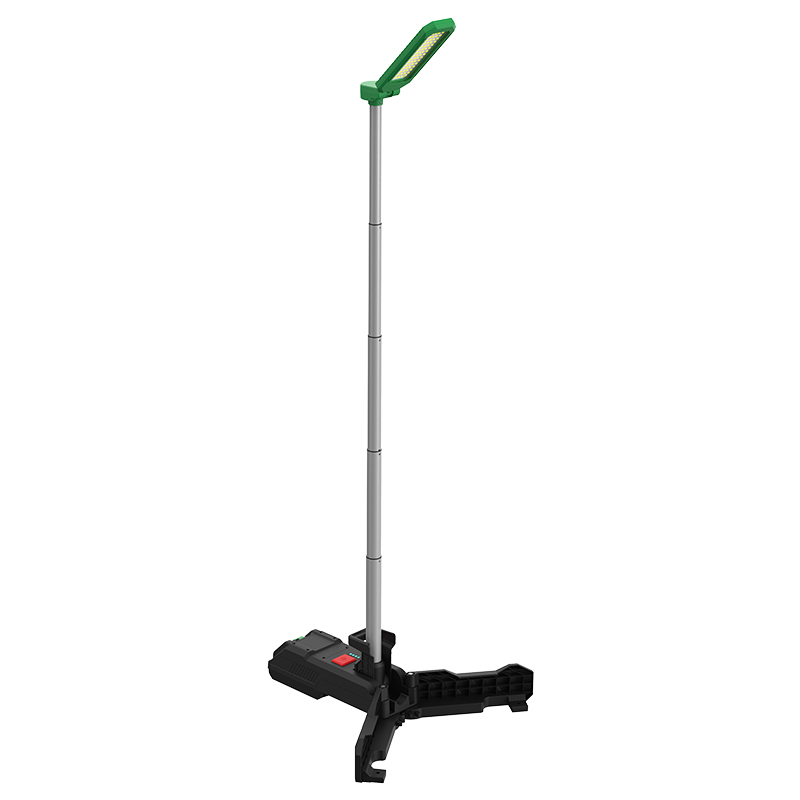
However, adopting battery platforms often creates ecosystem lock-in. Facilities usually own specific power tool brands. Investing in a completely new battery ecosystem just for lighting wastes capital. The Multi Battery Work Light solution resolves this issue perfectly. These specialized fixtures utilize interchangeable adapters. They accept multiple major-brand tool batteries securely. You achieve seamless fleet integration without buying redundant charging stations.
Despite the massive advantages of battery platforms, alternating current retains dominance in specific scenarios. Static, large-scale illumination projects heavily favor AC. Think of towering mast lighting or permanent warehouse bays. These applications demand ultra-high lumen outputs spanning massive areas. Achieving this intense brightness via batteries requires enormous power packs. The resulting weight and physical capacity limits quickly become prohibitive for elevated installations.
You should also specify AC when you need continuous, unmanaged runtime. Many industrial scenarios require active lighting 24 hours a day. Relying on cordless solutions introduces significant labor overhead. Crews must actively monitor, swap, and charge depleted battery packs. Hardwired AC fixtures eliminate this logistical burden entirely. Once installed, they provide infinite illumination without daily management or intervention.
Finally, evaluate your existing infrastructure leverage. Established sites often feature pre-routed commercial AC power distribution. If grid access already exists, installing plug-and-play AC fixtures remains highly cost-effective. You simply tap into the established electrical panels. There is no need to engineer separate low-voltage grids or manage localized charging hubs. AC excels when the infrastructure already supports it seamlessly.
Comparing these architectures requires a strict look at hardware performance. Energy efficiency and heat management represent the first critical metrics you should evaluate. Standard AC LEDs suffer from inherent conversion losses. They lose up to 15% of their consumed energy as heat during the rectification process. This wasted energy translates into higher operating temperatures inside the fixture housing. Native DC systems run significantly cooler. They process power more efficiently because they avoid this conversion penalty entirely.
Reliability and component lifespan also differentiate the two systems. In traditional LED lighting, AC drivers are historically the first point of failure. These drivers contain delicate capacitors sensitive to voltage spikes and thermal stress. High temperatures bake these components over time. Direct current fixtures bypass this vulnerability entirely. By eliminating the driver, you remove the weakest link in the chain. This streamlined architecture leads to potentially longer overall fixture lifespans in rugged environments.
Table: Hardware Performance Comparison
Feature | AC Architecture | DC Architecture |
|---|---|---|
Power Conversion | Requires internal driver/rectifier | Native operation, no conversion |
Heat Generation | Higher (due to conversion losses) | Lower (highly efficient processing) |
Component Vulnerability | High (drivers often fail first) | Low (bypasses sensitive capacitors) |
Efficiency Loss | Up to 15% lost as heat | Near zero conversion loss |
Every technology introduces unique friction points. If you plan to run wired DC lighting grids, you must address voltage drop. Direct current suffers from severe voltage degradation over long cable runs. Pushing low-voltage power across a massive job site requires thicker, more expensive copper wiring compared to alternating current. The physics of voltage drop make centralized wired DC systems challenging and expensive for sprawling footprints.
Battery lifecycle management presents another logistical hurdle for cordless setups. Cordless DC units require dedicated charging stations spread across the site. You must proactively manage theft prevention for high-value battery packs. Furthermore, lithium-ion cells suffer from rapid degradation when exposed to extreme temperature fluctuations. Leaving batteries in freezing conditions heavily reduces their effective runtime. Crews must actively cycle and maintain these power sources to ensure operational readiness.
On the other hand, AC systems carry strict compliance and safety liabilities. Regulatory bodies like OSHA enforce rigid safety requirements for high-voltage setups. You must install reliable GFCI protection across the entire grid. Cables demand heavy-duty, weather-resistant ratings to prevent environmental damage. Furthermore, job site machinery frequently snags or crushes trailing cables. A severed 120V line presents an immediate, lethal shock hazard and forces rapid work stoppages.
Making the final decision requires a structured, analytical approach. Follow this sequential auditing process to determine the best fit for your facility and crew.
Step 1: Audit site power status. Determine if grid power is live, stable, and easily accessible. If grid access is reliable, lean toward AC for your primary overhead illumination. Use localized DC units strictly for immediate task lighting. If grid power is completely absent, lean heavily into battery solutions.
Step 2: Assess environmental risks. Survey the immediate working environment. Are your crews operating in wet, highly metallic, or confined spaces? If these specific hazards exist, mandate low-voltage DC fixtures to eliminate fatal shock risks entirely.
Step 3: Evaluate fleet compatibility. Take a thorough inventory of your existing cordless tools. If you choose battery-operated fixtures, map your current tool platforms. Procure a versatile ecosystem that utilizes current battery assets to maximize your return on investment.
Step 4: Pilot testing. Never transition an entire fleet blindly. Test a hybrid approach on a single, isolated project phase. Gather crew feedback regarding runtime, brightness, and physical handling before standardizing your entire procurement strategy.
Neither lighting system universally defeats the other. Alternating current clearly wins on raw, uninterrupted scale. Direct current wins decisively on energy efficiency, personnel safety, and physical agility. Your ultimate job is to match the underlying technology to the specific environmental demand.
To optimize your site, consider these actionable next steps:
Deploy fixed AC overhead fixtures for continuous, wide-area illumination where infrastructure readily permits.
Equip mobile crews with localized, battery-powered units to eliminate trip hazards in highly dynamic zones.
Standardize your battery fleet using versatile adapters to prevent costly ecosystem lock-in.
Conduct a site-specific hazard assessment to enforce low-voltage mandates in damp or confined spaces.
Modern commercial operations increasingly adopt this strategic hybrid model. You achieve the best outcomes by supporting permanent high-voltage grids with portable, hazard-free task illumination.
A: Most standard AC bulbs will fail or operate improperly without an inverter. They rely on internal drivers designed specifically for alternating current. Pushing direct current through these drivers typically damages the internal capacitors. Always use dedicated fixtures engineered for the correct power type to ensure safe, reliable illumination.
A: Wired setups require specialized, thicker gauge cables. Direct current suffers from voltage drop over distance, demanding heavier copper wiring to maintain performance. Conversely, battery-operated models are entirely plug-and-play. They eliminate external wiring needs completely, relying instead on integrated proprietary or universal battery mounts.
A: Yes, modern lithium-ion platforms and high-efficiency LEDs allow cordless units to easily match standard high-voltage lumen outputs. However, maximum brightness rapidly depletes battery reserves. While peak output is identical, your practical brightness ceiling is often dictated by how long you need the fixture to run continuously between charges.


