


Views: 0 Author: Site Editor Publish Time: 2026-11-09 Origin: Site


Working a 10-hour shift deep inside an automotive engine bay or a sprawling fabrication shop takes a massive physical toll. You feel it in your back. You feel it in your knees. Yet, the most insidious exhaustion often starts right behind your eyes. Do you frequently clock out battling a dull headache, blurred vision, or dry eyes? Your lighting setup is likely the hidden culprit. Poor illumination silently destroys your ocular endurance. Specifically, the color temperature of your light dictates how efficiently your brain processes every wire, bolt, and schematic.
Understanding Correlated Color Temperature, or CCT, is the absolute baseline for engineering a safer, highly productive workspace. We will break down the biological science behind color temperature. We will look at exact parameters for extended operations. We will also explain why advanced optical features are strictly non-negotiable for modern industrial professionals.
Direct Impact on Fatigue: Color temperature alters circadian rhythms and cumulative eye strain over grueling shifts.
The Optimal Sweet Spot: A natural white output between 4000K and 5000K balances stark clarity with ocular comfort.
Color Rendering is Crucial: High color accuracy prevents the severe cognitive strain of struggling to differentiate subtle hues during precision tasks.
Glare Multiplies Strain: A perfect spectrum still triggers tension headaches if the diode is harsh. Diffused lenses are a hard requirement.
Positioning Matters: Adjustable, shadow-free beams eliminate the need for constant squinting and neck-craning.
To fix environmental fatigue, you must first define the metrics. Correlated Color Temperature measures the visual warmth or coolness of a light source. We express this in degrees Kelvin. It does not measure physical heat. It simply defines the specific color profile emitted by an LED chip. Grasping this scale is your first step toward professional workspace optimization. The spectrum breaks down into three core operational categories.
Warm Light 2700K to 3000K: Produces amber tones similar to a sunset. Highly relaxing. Completely unsuitable for detailed mechanical labor.
Neutral Natural Light 4000K to 5000K: Emits a crisp, clean white glow mimicking mid-day sunlight. Delivers massive contrast without feeling artificially harsh.
Cool Light 6000K and above: Features a distinct bluish-white tint. Think of high-intensity automotive headlights. It feels incredibly bright but becomes clinically abrasive over time.
A common rookie mistake on the job site is confusing CCT with raw brightness. Brightness is measured in lumens. CCT strictly measures color appearance. A fixture can feature a blistering 6500K rating while only outputting a dim 500 lumens. When sourcing industrial gear, treat color appearance and lumen volume as two completely separate parameters.
Looking at recent industrial safety audits, there is a massive shift happening across the manufacturing and automotive sectors. A decade ago, safety managers strictly focused on lifting mechanics and respiratory hazards. Today, visual ergonomics dominates the conversation. Research shows a direct correlation between harsh, high-Kelvin overhead lighting and end-of-shift error rates. Facilities are actively stripping out abrasive 6500K fluorescent tubes. They are replacing them with tunable, high-CRI LED systems. This transition is no longer just about worker comfort. It is a strict compliance measure to reduce defect rates and mitigate long-term liability related to chronic eye strain.
The biological response to your environment is immediate and profound. The specific Kelvin rating of your workspace exerts a measurable impact on ocular muscle endurance. This happens because the human eye processes different wavelengths in very different ways.
Cool white lights above 5500K emit a heavy concentration of blue wavelengths. Blue light carries massive energy. It suppresses melatonin production. Consequently, higher Kelvin ratings are fantastic for spiking short-term alertness during a midnight maintenance run.
However, this alertness demands a heavy physical toll. Short-wavelength blue light scatters erratically inside the human eye. The eye struggles to focus this fragmented light sharply onto the retina. To compensate, your ciliary muscles are forced into continuous micro-adjustments. After an 8-hour shift, this relentless flexing results in severe digital eye strain. You feel it as a burning sensation and a throbbing tension headache.
Conversely, very warm lights around 3000K emit longer, soothing wavelengths. Unfortunately, they present a massive operational hazard. Warm tones signal your brain that the day is over. They promote drowsiness. Furthermore, they destroy visual contrast. Try inspecting a hairline fracture on a cast-iron pump housing under warm lighting. You will inevitably squint. Squinting engages facial muscles and triggers a completely different type of muscular fatigue.
Daily engineering and maintenance responsibilities demand varying levels of visual acuity. No single setting is flawless for every scenario. Ergonomic engineers have established strict parameters based on real-world applications.
Task Type | Recommended CCT | Ideal Application | Fatigue Risk |
|---|---|---|---|
General Maintenance | 4000K - 5000K | Engine bays, wiring, assembly | Very Low |
Defect Inspection | 5500K - 6500K | Paint matching, scratch detection | High (Short bursts only) |
Relaxed Ambient | 2700K - 3000K | Break rooms, non-task areas | Low |
For mechanics and technicians pulling extended shifts, a natural white output between 4000K and 5000K is the undisputed sweet spot. It delivers the stark contrast required to identify stripped threads or faded wire stripes. Yet, it falls safely below the threshold where blue light scattering destroys your retinas. This natural spectrum keeps the brain alert without overstimulating the optic nerve.
Illumination pushing past 5500K remains highly effective for rapid, extreme-visibility tasks. The heavy blue-light content creates aggressive contrasts. It makes spotting micro-leaks incredibly easy. However, using this intense spectrum as your primary ambient illumination is a massive mistake. It is a leading driver of workplace fatigue. Reserve it as a supplementary tool.
Mastering color temperature is only half the battle. It absolutely does not guarantee that objects will appear true to their actual hues. The Color Rendering Index acts as the critical secondary metric for preventing cognitive fatigue. Measured on a scale from 0 to 100, CRI quantifies how accurately a source reveals true colors compared to ideal natural sunlight.
Operating under equipment with a low CRI washes out colors. They become muted or entirely indistinguishable. This creates immediate operational hazards on the floor. An electrician struggling to differentiate a dark blue wire from a black one inside a dim junction box is a disaster waiting to happen. When visual data is distorted, your brain works overtime to process the environment. That cognitive load translates directly into physical strain.
Specifically, the most effective solution is deploying a professional high CRI inspection light. Top-tier industrial models are typically rated at CRI 95 or above and paired with a natural 4500K output. This exact combination renders pigments flawlessly. Your eyes effortlessly distinguish subtle differences without a second thought.
Even with the perfect spectrum and flawless color rendering, your environment will still induce severe headaches if it produces excessive glare. Glare is the silent enemy of vision. It occurs when a concentrated source is significantly brighter than the surrounding area. It completely overwhelms the retina.
Raw LED diodes are intensely bright and highly focused. Direct exposure causes disability glare, temporarily blinding you. It also causes discomfort glare, leaving lingering afterimages floating in your vision. To combat this, professional equipment utilizes frosted lenses, specialized optical diffusers, and indirect reflectors. These engineered components take the abrasive beam of the LED and soften it. They spread the output evenly across a wider workspace.
For large-scale site illumination, like lighting up a commercial garage or a night-time construction zone, deploying an anti-glare LED flood light is an absolute necessity. High-end site lights utilize advanced SMD LED arrays housed behind impact-resistant polycarbonate diffusers. They provide the massive lumen volume required to navigate the area safely. More importantly, they do not blind workers who accidentally glance upward. This prevents the rapid pupillary constriction that triggers deep eye aches.
The angle and positioning of your light source carry just as much weight as the internal circuitry. Poor lighting angles create aggressive, sharp shadows across the workspace. When working under a chassis, shadows force your pupils to constantly dilate and constrict. Your gaze shifts between brightly lit metal and pitch-black crevices. This rapid, continuous adjustment is a primary driver of muscular fatigue.
Modern engineering solves this through Chip-on-Board technology. Unlike older panels featuring dozens of spotty diodes, COB packs multiple chips into a single, dense module. This produces a uniform wall of light. It is incredibly soothing to process and completely eliminates overlapping shadows.
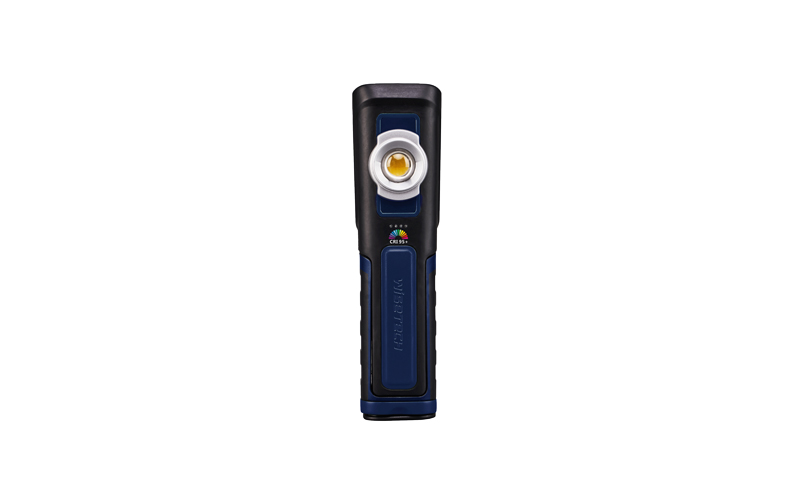
Furthermore, hands-free versatility is the cornerstone of ergonomic health. Securing a COB magnetic hand-held work light to a car hood or steel beam allows you to direct the beam precisely where required. Look for models featuring heavy-duty 180-degree rotating magnetic brackets and dual-color switching capabilities. By angling the glare away from your face and freeing up both hands, you eliminate the severe neck and ocular strain associated with biting a flashlight for hours on end.
Upgrading your gear is a massive step forward. However, how you implement that equipment into your daily workflow determines its ultimate effectiveness. Consider adopting these evidence-based best practices to preserve your visual health.
Never rely on a single, blindingly bright source in an otherwise pitch-black room. This extreme contrast forces your pupils into overdrive. Practice lighting layering instead. Ensure the room possesses adequate overhead ambient lighting to establish a baseline of visibility. Then, introduce targeted task lighting specifically on your focal point. The transition between the task area and the surrounding room should be smooth and gradual.
Even under the most pristine 4500K, high-CRI conditions, staring at a fixed distance for uninterrupted hours will fatigue your ciliary muscles. Optometrists universally recommend the 20-20-20 rule. Every 20 minutes, deliberately look at an object at least 20 feet away for a minimum of 20 seconds. This brief pause allows your focusing muscles to completely relax and reset.
Ensure your portable task lighting does not clash with the room's overarching ambient glow. If your shop's overheads are a warm 3000K, introducing a harsh 6500K task beam creates severe visual confusion. The brain struggles to adapt to two wildly different spectrums simultaneously. Keep your primary task illumination within 1000K of your ambient surroundings. This maintains a cohesive visual environment.
Eye fatigue should never be an accepted hazard of a demanding profession. By understanding the biological mechanics behind color temperature, you can take proactive control of your long-term visual health. Opting for a natural white spectrum between 4000K and 5000K delivers the ideal balance of clarity and comfort. It ensures you remain alert without burning out before the shift ends.
Ultimately, technical specifications like CCT are only one piece of the puzzle. Elevating the quality of your daily output requires investing in professional-grade tools designed specifically for human ergonomics. Utilizing high color rendering for accuracy, demanding anti-glare diffusers for ambient comfort, and leveraging magnetic COB technology for shadow-free precision will fundamentally transform your workflow. Protect your vision today. Your body will thank you tomorrow. Ready to upgrade your industrial lighting setup? Explore the full range of ergonomically designed, high-performance illumination tools at WiseTech Lighting to find the exact fixture engineered for your specific workspace demands.
For the vast majority of long-shift applications, a natural white range between 4000K and 5000K is considered optimal. It provides sufficient clarity to maintain focus without emitting the harsh, fatigue-inducing blue wavelengths prevalent in 6000K+ sources.
Absolutely. Low-quality illumination makes it incredibly difficult to distinguish fine details and subtle hues. This forces you to squint and strain your facial muscles. High CRI equipment renders colors accurately, allowing your brain to process visual data effortlessly, drastically reducing the risk of cognitive and muscular headaches.
This discomfort is typically caused by glare rather than the underlying color spectrum. Raw LED diodes are highly concentrated and intensely bright. To mitigate this, professionals should utilize fixtures equipped with frosted lenses or specialized optical diffusers. These components soften the beam and spread it evenly across the room.
While 6500K is not necessarily "too bright" since brightness is dictated by lumens, it is exceptionally "cool" or blue. It is fantastic for rapid, high-detail defect inspections. However, staring at a 6500K beam for an entire 8-hour shift can induce severe fatigue and negatively impact your natural sleep cycle.
COB LEDs generate a smooth, highly uniform wall of light. This entirely bypasses the multiple, overlapping shadows caused by older, multi-diode arrays. When combined with magnetic bases for hands-free positioning, COB tools ensure the beam is aimed perfectly at the task, maximizing both visibility and physical comfort.
Yes, adjustable lumen output is critical for visual ergonomics. Blasting a 5000-lumen beam at a reflective aluminum surface from two feet away will cause immediate glare blindness, regardless of the CCT. Utilizing a light with multiple brightness settings allows you to match the intensity to the specific task distance and surface reflectivity, significantly reducing optic nerve strain.
Yellow or warm light around 2700K to 3000K is biologically more relaxing and causes less retinal strain because it lacks high-energy blue wavelengths. However, for industrial work, yellow light provides terrible contrast. It forces you to squint to see fine details, which ironically causes muscular eye fatigue. For working environments, natural white 4000K to 5000K is the superior compromise.

