


Views: 0 Author: Site Editor Publish Time: 2026-09-13 Origin: Site


Selecting the right Work Light is not just about finding the brightest option on the shelf. It represents a critical safety, productivity, and compliance decision for professional environments. Relying solely on aggressive marketing claims often leads to poor investments. Exaggerated lumen counts, for example, can mask terrible battery lifespans. They can also introduce hidden workplace hazards like extreme heat or blinding glare. Professionals need equipment they can trust when environmental conditions get tough. This guide provides an evidence-based evaluation framework. We will help you decode complex technical specifications easily. You will learn how to match the right lighting architecture to specific industrial, automotive, or construction applications. By understanding the core metrics, you can ensure your teams operate safely and efficiently under any conditions.
Lumen output must be balanced with beam angle and CRI: Brightness without clarity or color accuracy causes eye fatigue and costly errors in detail-oriented tasks.
Power architecture dictates operational scalability: Cordless solutions offer mobility but require strategic battery fleet management, whereas corded/hybrid models ensure continuous high-output operations.
Durability requires verifiable ratings, not just rugged design: True industrial resilience is measured by specific IP (Ingress Protection) and IK (Impact Protection) ratings.
Form factor and mounting dictate usability: A light's value drops significantly if it cannot be positioned securely and safely in complex work zones.
Before reviewing technical specifications, you must clearly map out your exact environmental demands. We recommend following a structured approach to evaluate your workspace.
Identify the Core Application. Broad area illumination requires fundamentally different fixtures than localized tasks. Site lighting floods large zones to keep foot traffic safe across open terrain. Conversely, under-hood automotive repairs or intricate electrical panel inspections demand focused, high-intensity beams.
Conduct Risk and Compliance Profiling. Assess your environment for hazardous elements. Volatile gases, combustible dust, and extreme moisture present severe daily dangers. These conditions mandate specific safety certifications. You might need ATEX-rated fixtures or OSHA-compliant equipment. Never compromise on these rigid compliance standards.
Outline Implementation Realities. Logistical constraints define how useful a fixture will actually be in the field. Evaluate continuous power availability across your site. Consider physical space limitations inside tight mechanical rooms or tunnels. Determine if your crew requires hands-free operation to hold tools safely while working.
Defining these parameters first narrows your available options. You avoid over-investing in unnecessary features. You also prevent critical safety oversights during the procurement process.
Raw brightness often misleads industrial buyers. Manufacturers routinely inflate lumen counts to drive retail sales. However, true optical quality relies on several interrelated metrics. You need the perfect balance for your specific tasks.
First, understand the difference between lumens, lux, and beam angle. Lumens measure the total light emitted by the diodes. Lux measures directional intensity on a specific surface area. A fixture pushing 10,000 lumens is useless if its beam spread scatters light everywhere. Directional intensity matters much more for precise mechanical work. We recommend a baseline of 1,000 to 3,000 lumens for localized tasks. For large area floods, you should target 5,000 lumens or more.
Next, consider the Color Rendering Index (CRI). CRI measures how accurately a light source reveals true, natural colors. A CRI of 80+ serves as a reliable standard for general construction and framing. However, detailing, painting, and electrical wire identification demand higher precision. For these tasks, a CRI of 90+ is absolutely mandatory. It prevents costly errors when distinguishing between subtly different wire colors in dark panels.
Finally, evaluate color temperature using the Kelvin scale. We strongly recommend 4000K to 5000K for professional environments. This specific range provides optimal visual contrast. It mimics natural daylight closely. This reduces eye strain significantly during long, demanding shifts. You should warn your purchasing team against overly blue lights exceeding 6000K. They create harsh, piercing glare and cause rapid visual fatigue.
Table Title: Optical Specification Baselines and Best Practices
Optical Metric | Recommended Baseline | Primary Professional Use Case |
|---|---|---|
Lumens (Localized) | 1,000 - 3,000 | Under-hood repair, plumbing, panel inspections. |
Lumens (Area Flood) | 5,000+ | Site lighting, large room illumination, outdoor staging. |
CRI | 90+ | Automotive detailing, paint matching, electrical work. |
Color Temperature | 4000K - 5000K | All extended-shift tasks requiring high contrast. |
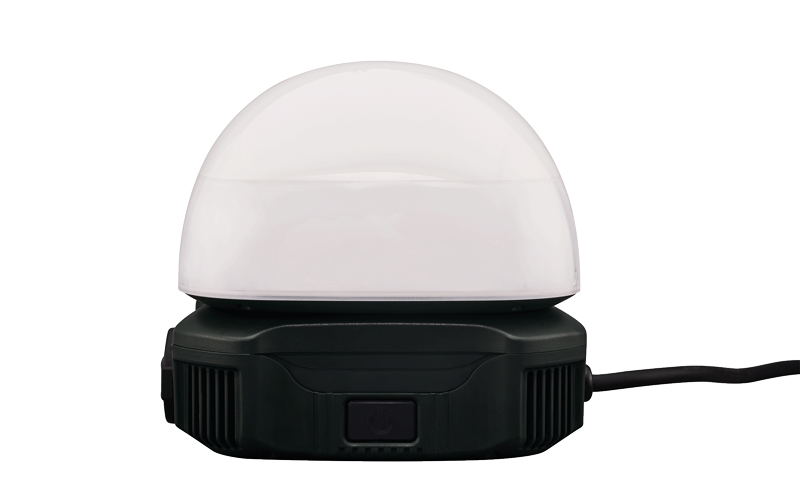
A reliable Work Light relies heavily on robust power delivery. Battery technology dictates your daily operational tempo. Lithium-Ion (Li-ion) systems dominate the modern industrial market. You must evaluate battery capacity carefully, measured in Amp-hours (Ah). Frame this capacity against the fixture's maximum lumen output. This calculation reveals realistic runtimes.
Maximum Output Reality: Maximum lumen output rarely sustains a full shift. Always verify the continuous runtime at the highest setting.
Step-Down Programming: Manufacturers use intelligent step-down programming to save battery life. Many models drop to 50% brightness after just 30 minutes.
Thermal Throttling: Fixtures automatically dim when internal temperatures spike to protect internal circuits.
Hybrid power solutions offer a tremendous strategic advantage. These versatile units run off a battery pack for ultimate mobility. When placed in static locations, they plug directly into standard AC power. This dual functionality ensures continuous high-output operations. It eliminates costly downtime caused by dead batteries during critical project phases.
Ecosystem compatibility remains essential for B2B buyers. Look for bare-tool models. They integrate seamlessly into your existing 12V, 18V, or 20V power tool battery fleets. This approach reduces upfront procurement costs significantly. You avoid buying redundant chargers and proprietary battery packs. It simplifies site logistics and keeps your crew moving efficiently.
Rugged aesthetics mean very little in harsh industrial environments. True durability requires verifiable, standardized engineering ratings. You must decode Ingress Protection (IP), Impact Protection (IK), and thermal management specifications.
Chart Title: Common IP and IK Ratings Explained
Rating Level | Technical Meaning | Practical Environment Application |
|---|---|---|
IP54 | Dust and splash resistant. | Indoor workshops, clean manufacturing floors. |
IP65 | Heavy dust and water jet resistant. | Outdoor construction sites, heavy rain exposure. |
IP67 | Survives temporary submersion. | Extreme plumbing, marine environments, trench work. |
IK07 | Withstands 2-joule impact. | General handling, occasional minor drops. |
IK10 | Withstands 20-joule impact. | Heavy industrial zones, repetitive concrete drops. |
Translating IP ratings to real-world conditions prevents catastrophic equipment failures. An IP54 rating handles standard dust and minor fluid splashes. IP65 models survive heavy dust environments and direct low-pressure water jets. If your team works in deep trenches, demand IP67. It survives temporary submersion in water.
Impact Protection uses the IK scale, ranging from IK00 to IK10. Distinguish carefully between cosmetic ruggedness and engineered resilience. Rubber bumpers look tough but often hide fragile internal components. High IK ratings indicate true internal shock absorption. They guarantee the internal circuitry survives repeated drops onto solid concrete floors.
Do not overlook thermal management risks. High-output LEDs generate intense internal heat. Poorly managed heat leads to severe burn hazards for operators. It also causes premature LED degradation over time. Evaluate the heat sink designs carefully. Look for deep aluminum cooling fins. Active thermal throttling features also prevent the unit from melting its own casing during extended use.
A brilliant fixture loses its value immediately if you cannot position it correctly. Form factor and mounting modularity dictate overall workplace usability. Complex work zones require highly adaptable positioning equipment.
Evaluate the base and mounting modularity first. Magnetic bases prove essential for mechanics and structural steelworkers. Test their holding force rigorously. A weak magnet becomes a dangerous falling hazard near heavy machinery. Check the durability of carabiner hooks for overhead suspension. Ensure the base includes standard tripod threading. Sizes like 1/4"-20 or 5/8"-11 allow quick integration onto standard construction site tripods.
Articulation and targeting separate average fixtures from professional-grade tools. Assess the friction hinges thoroughly. They must hold heavy light heads steady despite constant nearby vibration. Look for advanced rotation capabilities like 180-degree or 360-degree pivoting heads. These features allow you to direct the beam precisely. You avoid the frustrating process of repositioning the entire heavy unit continuously.
Finally, address portability versus output trade-offs. This represents a fundamental physical reality in lighting design. High-lumen, long-runtime fixtures require massive batteries. They also need heavy metal heat sinks to dissipate heat. Guide your purchasing decisions based on strict weight limits. Headlamps and small inspection pens suit tight, mobile tasks perfectly. Heavy pedestal arrays belong on static, wide-open sites. Balance your need for extreme brightness against the physical strain on your daily workforce.
Your decision process requires a disciplined, logical matrix. Start by defining your absolute environmental safety requirements. Next, select the specific optical specifications required for the daily tasks. Choose a power ecosystem matching your logistical realities and existing tools. Finally, verify the manufacturer’s durability ratings to ensure true longevity.
Before making your next purchase, take immediate action. Audit your current power tool battery platforms to find compatible bare tools. Assess the primary workspace conditions where your teams struggle most. Gathering this field data first ensures your investment truly enhances site safety. Once you map these variables, you can confidently request quotes and finalize your equipment upgrades.
A: Under-hood flood applications generally require 1,000 to 2,000 lumens to illuminate the entire engine bay effectively. Conversely, tight-space inspection pens only need 100 to 300 lumens. Too many lumens in a confined space create blinding glare, so choose based on the specific mechanical task.
A: No. IP ratings strictly measure resistance to dust and moisture ingress. Explosion-proof or intrinsically safe fixtures require distinct ATEX or hazardous location certifications. Never use a standard high-IP fixture in areas containing volatile gases or combustible dust.
A: Manufacturers program step-down features and thermal throttling into the circuitry. As the LED generates excess heat, the system lowers the output to prevent burn hazards and battery damage. Natural voltage drop-off as the lithium-ion battery drains also contributes to this dimming effect.
A: High CRI is usually unnecessary for broad framing or site illumination tasks. Standard 80 CRI fixtures provide adequate visibility at a lower cost. However, high CRI becomes critical during the finishing phases. Electricians and painters rely on it heavily for accurate wire identification and color matching.

