


Views: 0 Author: Site Editor Publish Time: 2026-09-03 Origin: Site


Professional trades and facility maintenance crews operate in highly unpredictable environments. Reliable power access is rarely guaranteed when you step onto an active job site. Relying solely on corded lighting creates severe tripping hazards and restricts mobility across large spaces. Conversely, purely cordless units risk sudden battery depletion right in the middle of a critical task. This sudden darkness halts productivity and forces workers to scramble for replacements.
The hybrid solution offers a significantly better way forward. We define the hybrid work light as a highly adaptable illumination system operating via removable rechargeable batteries or direct AC wall power. This guide moves beyond basic lumen counts to give you practical, field-ready insights.
We will explore how these adaptable systems integrate directly into your daily operations. You will learn how to evaluate operational ROI, ensure strict safety compliance, and navigate the practical realities of upgrading your fleet. Ultimately, this approach transforms how your team manages job site visibility.
Hybrid work lights eliminate job site downtime by offering a seamless transition between cordless agility and corded continuous runtime.
Integrating hybrid units reduces equipment redundancy (buying separate corded and cordless models) and standardizes battery ecosystem management.
Safety compliance improves significantly through the reduction of extension cord tripping hazards in high-traffic or wet environments.
Evaluation requires weighing the premium upfront cost against long-term durability, thermal management, and existing tool battery platform compatibility.
Many contractors drastically underestimate the silent productivity drain caused by inadequate illumination. You might consider dead batteries a minor inconvenience. However, downtime accumulates rapidly across a large crew. Workflow interruptions represent a massive hidden expense. Workers waste valuable hours sourcing distant power drops across unfinished buildings. They route heavy extension cords around complex structural obstacles just to power a standard Work Light. Purely cordless models also disrupt momentum. A depleted battery means walking back to the charging bay, swapping battery packs, and returning to the task. These small delays destroy labor efficiency.
Safety compliance presents another major hurdle for site managers. Cord clutter remains a leading cause of OSHA-cited tripping hazards. Wet environments amplify these safety risks significantly. Extension cords trailing through active puddles create severe electrical liabilities. Supervisors constantly monitor cord placement to prevent accidents. This micromanagement diverts attention from actual construction or maintenance tasks. A single tripping incident can trigger costly workers' compensation claims and project delays.
Equipment bloat heavily strains procurement budgets. Companies often maintain duplicate fleets to compensate for power source limitations. They purchase heavy corded units specifically for long-duration tasks. They then buy smaller battery-powered units for confined space operations. This dual-fleet strategy clutters supply closets and inventory rooms. It aggressively complicates daily maintenance schedules. Fleet redundancy forces crews to transport twice the gear required for a single job. You ultimately pay to store, transport, and maintain equipment you only use half the time.
Modern lighting technology beautifully bridges the gap between mobility and endurance. The dual-power architecture fundamentally changes how crews operate on-site. The ability to pivot between power sources eliminates the traditional bottlenecks associated with job site visibility.
Uninterrupted Runtime: Teams enjoy continuous AC power whenever wall outlets are available. Grid outages or localized breaker trips no longer plunge the room into dangerous darkness. You can instantly switch over to DC battery power. This seamless transition keeps your crew working safely during unexpected power losses. They finish the task without scrambling for flashlights.
Ecosystem Consolidation: Professional-grade models integrate directly into major tool battery platforms. You do not need a completely separate battery system for your illumination gear. You maximize the utilization of existing 18V or 20V battery inventories. Cross-compatibility aggressively reduces the number of varied chargers required on site. This standardization simplifies daily equipment checklists.
Adaptive Output Management: Intelligent internal circuitry does much more than just shine a light. Select models serve a brilliant dual purpose as localized charging bays. They automatically charge the attached battery while the unit remains plugged into AC power. This clever feature turns your lighting fixture into an essential power management hub.
Incorporating a Hybrid Work Light simplifies daily site logistics. Plumbers, electricians, and drywallers carry fewer items onto the floor. They experience zero delays when shifting from wired rooms to completely unpowered zones. The architecture adapts to the environment instead of forcing the environment to accommodate the tool.
Upgrading your illumination strategy directly impacts job site safety scores. Dual-power systems actively mitigate daily hazards inherent to active construction zones. Safety officers strongly prefer equipment adapting to changing hazard conditions.
Hazard Mitigation: Running cordless in high-traffic corridors significantly reduces cord-trip liabilities. Emergency egress routes remain entirely clear of obstacles. Workers move faster across complex scaffolding systems without dragging heavy cables behind them. This mobility proves crucial during rapid site evacuations.
Environmental Resilience (IP Ratings): Dust and water ingress constantly threaten sensitive electronics. High-quality models are built to strict IP54 or IP65 testing standards. These rigorous ratings protect the internal AC/DC switching circuits from intrusion. Your gear easily survives sudden rainstorms and thick drywall dust without short-circuiting.
Thermal Advantages: Legacy halogen fixtures present severe burn hazards to anyone brushing against them. They also create genuine fire risks near flammable materials like sawdust or insulation. Modern LED hybrid units eliminate these specific dangers entirely. The housing remains cool to the touch even during extended AC-powered runs.
Safety managers appreciate the immediate reduction in electrical citations. Clean, cord-free floors keep strict inspectors happy and workers highly secure. Improved thermal management prevents accidental contact injuries in cramped utility spaces. You proactively eliminate common risks before they escalate into recordable incidents.
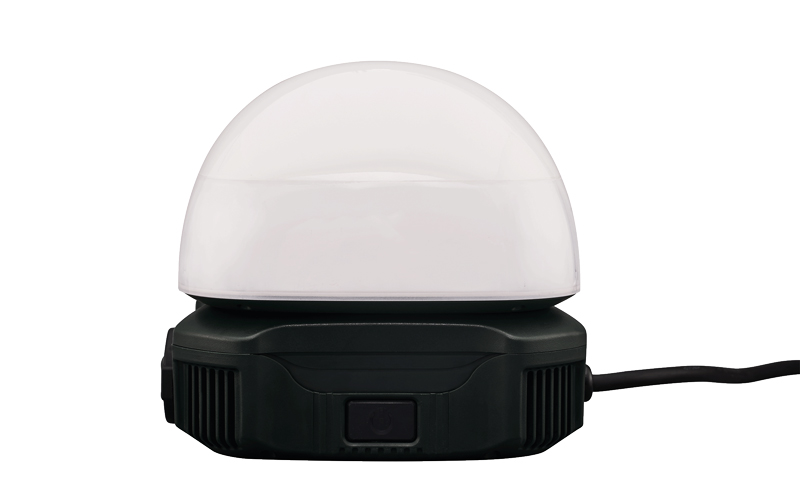
Selecting the optimal model requires careful scrutiny of manufacturer specifications. Do not rely solely on the largest lumen number printed boldly on the box. True utility relies on how the device manages power draw and physical placement.
You must evaluate true lumen output across both power modes. Many systems deliberately throttle lumen output by 30-50% when running on battery power. This internal throttling preserves valuable runtime. You must ensure the DC output still meets your minimum lux requirements for detailed tasks. A dim light causes severe eye strain and quality control errors.
Assess battery platform lock-in carefully. Avoid models requiring a proprietary internal battery at all costs. If a proprietary internal battery degrades, the entire unit permanently loses its cordless functionality. Instead, choose models accepting removable tool batteries strictly matching your current fleet. If your team uses DeWalt, Makita, or Milwaukee tools, your lighting should accept those exact packs.
Look deeply into daisy-chaining capabilities for large-scale site illumination. Check if the AC mode supports integrated pass-through receptacles. This smart feature allows you to link multiple units together without overloading limited wall circuits. Finally, evaluate the physical form factor. Strong base stability, magnetic mounting options, and tripod compatibility are absolutely essential for multi-directional task lighting.
Hybrid Light Selection Criteria
Feature | What to Look For | Why It Matters |
|---|---|---|
Output Discrepancy | Stated AC vs. DC lumen ratings | Prevents unexpected dimming when switching to battery power. |
Battery Interface | Removable pack compatibility | Ensures the light outlives a single battery cell's lifespan. |
Pass-Through Power | Built-in AC receptacles | Allows linking multiple lights from a single wall outlet. |
Mounting Versatility | Magnets, hooks, tripod threads | Keeps the light elevated, preventing shadows and floor clutter. |
Adopting dual-power illumination involves certain practical trade-offs. You must carefully balance the immediate workflow benefits against the physical realities of field implementation. Understanding these factors prevents buyer's remorse.
Incorporating both an AC transformer and a complex battery interface adds unavoidable weight. A hybrid fixture feels noticeably heavier than a dedicated single-source model. Crews must account for this extra bulk during daily transport and overhead mounting. A heavier base provides excellent stability on uneven floors, but it demands secure clamping when suspended above a workspace.
Upfront capital expenditure also demands careful consideration. Hybrid technology carries a 20-40% price premium over standard corded LED units. You must calculate your true ROI based strictly on labor time saved rather than the initial unit cost. Workers spend zero hours running cords, searching for active outlets, or taping down cables. This immediate efficiency boost easily justifies the higher initial purchase price within the first few months of deployment.
Watch out for accelerated battery degradation. Leaving removable lithium-ion batteries docked in a unit exposed to extreme job site heat damages the internal cells. Heat represents the primary enemy of battery longevity. You should standardize strict best practices for battery storage. Always instruct crews to remove packs from the housing during long-term storage or under direct summer sun. Properly managed equipment lasts significantly longer and yields a substantially higher return on your investment.
A hybrid lighting solution is never just a luxury tool. It operates as a vital risk-mitigation and efficiency asset for demanding professional environments. Volatile power access no longer needs to dictate your project timelines or compromise site safety.
Consider these actionable next steps to upgrade your operations:
Audit your current lighting fleet to identify unnecessary equipment redundancy.
Verify your dominant tool battery platform to ensure seamless cross-compatibility.
Pilot one or two high-lumen hybrid units in your most challenging operational zones.
Measure the direct workflow impact and labor time saved by eliminating heavy cord management.
Empower your crew with adaptable, modern tools. You will immediately notice smoother daily operations, fewer interruptions, and drastically improved site safety metrics.
A: Not always. Many manufacturers deliberately step down the maximum lumen output when operating on battery to extend runtime and manage heat. You should always check the separate AC and DC lumen specifications carefully before purchasing to ensure it meets your needs.
A: It depends heavily on the specific model. Premium models feature integrated charging circuits. However, budget or mid-tier units often only draw power from the battery and still require a completely separate dedicated charger.
A: Only if they carry a verified IP rating of IP54 or higher. However, you must apply extra caution when using the AC power cord in wet conditions. You absolutely require proper GFCI protection to prevent shock hazards.
A: If the light will never leave a dedicated, fully wired workbench, a standard corded LED provides far better cost-efficiency. The hybrid price premium is justified primarily by frequent mobility and highly unpredictable power access.

