


Views: 0 Author: Site Editor Publish Time: 2026-09-06 Origin: Site


Many buyers stare at lighting specifications and wonder if a 500W unit will actually illuminate their specific job site, garage, or remodeling project. You want absolute certainty before setting up your gear in a dark environment. Historically, the "500W" label refers to legacy halogen units. These traditional fixtures dictate both your light output and some significant heat considerations. Understanding their true reach prevents frustrating shadows and serious safety hazards on the floor. This guide provides exact square-footage estimates tailored to different task types. We will offer a robust evaluation framework for your equipment choices. Ultimately, you will discover how traditional 500W units stack up against modern LED alternatives for your workspace.
A standard 500W halogen work light produces roughly 8,000 to 10,000 lumens.
Effective coverage ranges from **150 sq. ft. (for precision tasks)** to **400 sq. ft. (for general visibility)**.
Wattage measures power draw, not brightness; modern LED equivalents match this coverage using only 50W to 100W.
Safety compliance and thermal management are the primary limiting factors for 500W halogen deployment.
People often confuse power consumption with brightness. You must separate wattage from lumen output to understand area coverage accurately. A traditional 500W halogen Work Light consumes 500 watts of electrical power from your wall outlet or generator. In return, it yields roughly 8,000 to 10,000 lumens. This lumen rating serves as the actual measure of visible light emitted from the bulb. Knowing the lumen output gives you a reliable baseline to calculate how far the light will travel before fading into darkness.
You must also account for the inverse square law when planning your site. Light intensity drops exponentially as distance increases from the source. If you place a target five feet away from the bulb, it receives a certain amount of light. If you move that target ten feet away—doubling the distance—it does not receive half the light. It receives only one-quarter of the brightness. You cannot simply throw a massive light source in the far corner of a giant warehouse and expect even illumination across the entire floor.
Let us establish a baseline coverage estimate. We assume a standard 120-degree beam angle for a typical flood-style fixture. If you mount a single unit at a 5-foot height, it illuminates a 15-by-15 foot room effectively. This setup gives you about 225 square feet of usable work area where you can clearly identify tools and materials.
These numbers rely on a few transparent assumptions. Coverage figures assume you have standard 8-to-10 foot ceiling heights. They also assume relatively light-colored walls. White drywall or pale concrete reflects light back into the space, creating a brighter ambient environment. Darker walls, unpainted wood framing, or expansive outdoor night skies will absorb the light, reducing your functional coverage area significantly.
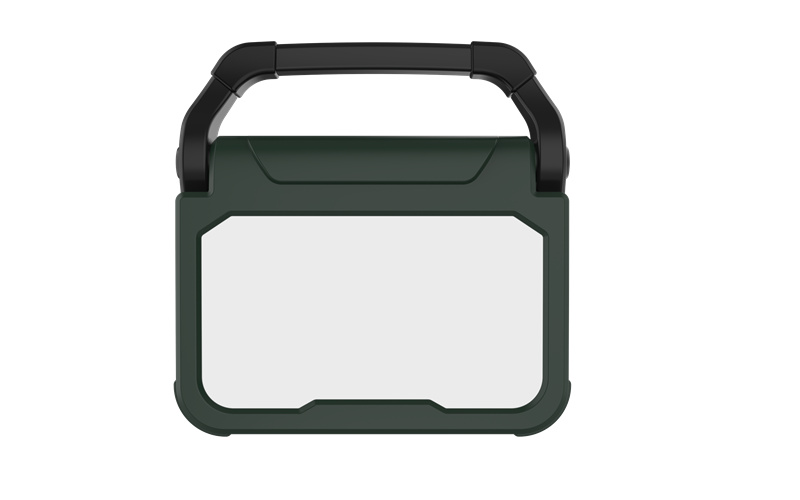
Different jobs require drastically different light levels to ensure quality and safety. Industry professionals measure this surface brightness in foot-candles. One foot-candle equals one lumen per square foot. Understanding your specific task requirements prevents eye strain and costly rework.
Fine detail work demands high visibility. When you match paint colors, splice thin gauge wires, or apply automotive clear coats, you need maximum clarity to prevent errors.
Requirement: You need about 50 or more foot-candles of light hitting the surface directly.
500W Coverage Limit: Roughly 100 to 150 square feet.
Implementation Reality: Shadows quickly become a major issue in tight spaces. You cannot rely on a single light source for painting an entire room. Your own body will cast a shadow over your work area. You often need secondary lighting on the opposite side to eliminate dark spots.
General building tasks allow for slightly lower brightness levels. You need enough light to read a tape measure clearly and safely operate a circular saw, but you do not need surgical-level illumination.
Requirement: You need about 30 foot-candles.
500W Coverage Limit: Roughly 200 to 250 square feet.
Moving heavy debris, locating materials in a storage bay, or walking through a cluttered site requires basic spatial awareness to avoid tripping hazards.
Requirement: You need about 10 foot-candles. This minimal level meets standard OSHA compliance for general interior construction areas.
500W Coverage Limit: 400 or more square feet.
Coverage Estimates by Task Type
Task Category | Required Foot-Candles | Estimated Max Coverage Area (500W) | Common Applications |
|---|---|---|---|
Precision Work | 50+ | 100 - 150 sq. ft. | Electrical wiring, painting, detailing |
General Construction | 30 | 200 - 250 sq. ft. | Drywall hanging, framing, plumbing |
Site Navigation | 10 | 400+ sq. ft. | Demolition, staging, storage areas |
The lighting industry has evolved drastically over the last decade. We must compare the 500W halogen baseline against modern alternatives to understand true job site efficiency. You will find a massive efficiency gap between older and newer technologies. A 50W to 100W LED High Lumen Work Light produces the exact same 8,000 to 10,000 lumens as the older units. It achieves this high output while drawing a fraction of the electricity.
Power supply limits consistently dictate your job site capabilities. A standard 15-amp residential circuit can handle roughly 1800 watts in total. To maintain safety margins, electricians strongly recommend a continuous load of only 1440 watts. Because a single 500W fixture draws over 4 amps, you can safely plug in only two halogen lights on a single breaker. Running three units draws 1500W, pushing the circuit dangerously close to its limit and risking a tripped breaker. This severely restricts your lighting scalability across larger spaces. Conversely, that identical 15-amp circuit can run dozens of LED equivalents simultaneously without ever stressing the electrical panel.
Generators present another major operational hurdle. Off-grid sites rely entirely on portable power sources. Relying on heavy-draw 500W halogens drains portable generators incredibly fast. Every watt wasted on heat reduces the power available for your heavy power tools. Upgrading to an LED setup dramatically reduces your fuel consumption. You spend less time refilling gas tanks and more time completing the actual project.
Brightness is only one piece of the job site puzzle. Safety constraints often dictate where you can legally and practically place a fixture. Understanding these rules protects your property and your crew.
Consider the severe thermal hazards associated with older technologies. Surface temperatures of 500W quartz-halogen bulbs frequently exceed 1,000°F (530°C). This extreme heat creates immense fire risks. You cannot safely place these units near exposed fiberglass insulation, airborne sawdust, or combustible paint fumes. They also pose severe contact-burn risks. Brushing accidentally against the metal housing in a tight crawlspace can cause instant, severe injury. Furthermore, if a rogue drop of cold water or sweat hits the blazing hot glass of a halogen bulb, it can shatter violently.
Regulatory bodies take these hazards very seriously. OSHA and NFPA compliance rules require heavy-duty wire guards over the glass faces of high-heat halogen units. You must ensure completely stable placement to prevent accidental tip-overs. A knocked-over halogen lamp can ignite a canvas drop cloth or cardboard box in a matter of seconds.
Physical fragility also causes costly downtime. Halogen filaments remain incredibly vulnerable to standard job site vibrations. Dropping the unit, or even just knocking the stand heavily with a lumber board, often breaks the glowing filament. You face the operational frustration of frequent bulb replacements. Workers lose valuable hours driving to the hardware store for fragile spare parts instead of finishing the task at hand.
You must evaluate your physical environment thoroughly before buying lighting gear. Form factor matters just as much as pure lumen output. Selecting the right design ensures the light goes exactly where you need it.
Pay close attention to the form factor versus your ceiling height. Choose a floor stand for lower-level tasks like automotive repair, flooring installation, or baseboard painting. A low, floor-level angle helps reveal surface imperfections on the ground. Alternatively, choose a telescoping tripod when you need broad room coverage. Elevating the fixture to six or seven feet helps mimic natural overhead lighting. This elevated position drastically reduces harsh horizontal shadows created by workers walking in front of the beam.
You must also evaluate durability metrics. Work sites destroy fragile equipment quickly.
IP Ratings (Ingress Protection): Look for an IP65 rating at minimum if you plan to work outdoors or in wet conditions. This rating guarantees protection against fine dust ingress and low-pressure water jets, preventing moisture from destroying the internal electronics.
IK Ratings (Impact Protection): Look for IK07 or IK08 ratings to guarantee impact resistance. Tools fall off ladders, and materials swing unexpectedly. Your fixture housing and lens must survive the daily chaos of a busy site.
Color temperature impacts your daily comfort and visual accuracy. Modern fixtures offer distinct options usually in the 4000K to 5000K range. This cooler, daylight-mimicking white light is optimal for professional environments. It heavily reduces eye strain over long shifts. It also allows you to accurately assess paint finishes and electrical wire colors. Older halogen bulbs cast a distinctly warm, yellow hue. This yellow tint easily distorts your perception of colors, making a blue wire look green or white paint look cream.
Use a simple shortlisting logic when making your decision. If your budget is the absolute only constraint, and heat is a non-issue in a wide-open outdoor space, traditional 500W halogens still function. However, you face completely different realities indoors. If scalability, safety, cool operation, and long-term durability are required, you must upgrade to a modern LED solution to protect your workspace.
Proper illumination directly impacts the quality and safety of your labor. Relying on outdated specifications can leave you working in the dark or battling dangerous heat.
A 500W unit easily covers a standard two-car garage for general construction tasks but falls significantly short for precision work in that same large area.
Always evaluate your job site's specific safety constraints—especially heat risks and available breaker capacity—before making a final purchase decision.
Use elevating tripods to achieve full-room coverage and utilize low floor stands for targeted, ground-level tasks.
Opt for modern LED alternatives whenever circuit capacity or generator loads limit your overall setup.
A: It is highly discouraged. Halogen work lights produce massive amounts of heat, creating a severe fire hazard if placed near nylon softboxes or diffusion gels. Additionally, they emit inconsistent color temperatures and often cause noticeable flickering on digital video. Professional photography requires dedicated, color-accurate, and flicker-free lighting.
A: A dual-head unit does not magically double your illumination distance. Instead, it increases the light intensity within a roughly 400-square-foot radius. It heavily reduces shadows by allowing you to point two distinct beams in slightly different directions, overlapping the light for much better precision visibility.
A: Traditional halogens generate extreme heat. Many models feature built-in thermal overload switches that automatically cut power when the housing gets dangerously hot. Alternatively, pulling 500 watts on a shared residential circuit might be tripping your main breaker due to a high overall amp draw from other plugged-in tools.

