


Views: 0 Author: Site Editor Publish Time: 2026-10-18 Origin: Site


Ever tried adjusting a light with grease-covered hands? Traditional lighting forces you to pause, strip off heavy work gloves, and fumble blindly in the dark. This seemingly small interruption wastes valuable time and transfers damaging dirt to sensitive equipment. Upgrading to a Motion Sensor Headlamp directly resolves these daily frustrations. It keeps your workflow seamless and your gear pristine.
Instant Activation: Optical technology allows operators to toggle illumination via a simple hand wave, bypassing physical contact entirely.
Enhanced Safety: Touchless operation minimizes task interruption. Professionals maintain critical focus and physical stability on ladders or scaffolding.
Unmatched Convenience: Integration with wide-angle LED technology delivers uniform lighting without harsh glare during close-proximity tasks.
Cost-Effective Durability: Internal lithium-ion power lowers long-term operational costs while ensuring consistent voltage output.
Environmental Resilience: High-grade optical sensors resist particulate ingress and moisture, maintaining functionality in severe job site conditions.
Industrial and automotive environments introduce chaotic variables. Standard lighting equipment rarely handles these well. Relying on traditional push-button interfaces in these settings creates measurable inefficiencies, accelerates equipment degradation, and introduces unnecessary safety risks.
Recent occupational safety analyses reveal a definitive industry shift toward touchless tool interfaces. Safety managers across automotive and heavy industrial sectors are actively phasing out mechanical-switch lighting. The focus is now on mitigating cross-contamination and reducing ergonomic strain. This evolution perfectly mirrors the broader industrial demand for smart, friction-free gear that keeps workers focused on complex diagnostics rather than wrestling with their personal protective equipment.
Heavy-duty leather gloves, insulated winter wear, or chemical-resistant gauntlets severely limit tactile dexterity. When a worker needs to adjust a standard headlamp, they face a disruptive choice. They must either fumble blindly for a recessed button or stop working entirely to peel off their gloves.
While this micro-interruption seems trivial in isolation, the cumulative productivity loss is significant. Removing and replacing gear multiple times per hour disrupts the workflow and breaks concentration. In time-sensitive operations, these constant lighting adjustments translate directly into lost labor hours.
The physical environment of a job site is inherently hostile to electronics. Operators using soiled hands to actuate a physical switch inadvertently transfer oil, mud, drywall dust, and chemical solvents directly onto the device housing.
From a mechanical standpoint, particulate matter acts as a highly effective abrasive. Microscopic dirt particles seep into the narrow crevices surrounding traditional push-buttons. Over time, this grit deteriorates the internal silicone seals and damages the microswitches. Furthermore, petroleum-based greases chemically degrade rubberized button covers. This forces frequent equipment replacements and drives up overhead costs.
Safety protocols in manual labor heavily emphasize physical stability. Technicians working on uneven terrain must maintain three points of contact at all times. Reaching up to press a button forces the worker to release their grip, momentarily compromising balance and increasing fall risks.
Specifically, cross-contamination poses a serious yet often overlooked hazard. Mechanics handling toxic fluids or painters working with heavy solvents risk transferring hazardous chemicals to their faces. Eliminating the need to touch the forehead area drastically reduces the risk of accidental chemical exposure to the eyes or skin.
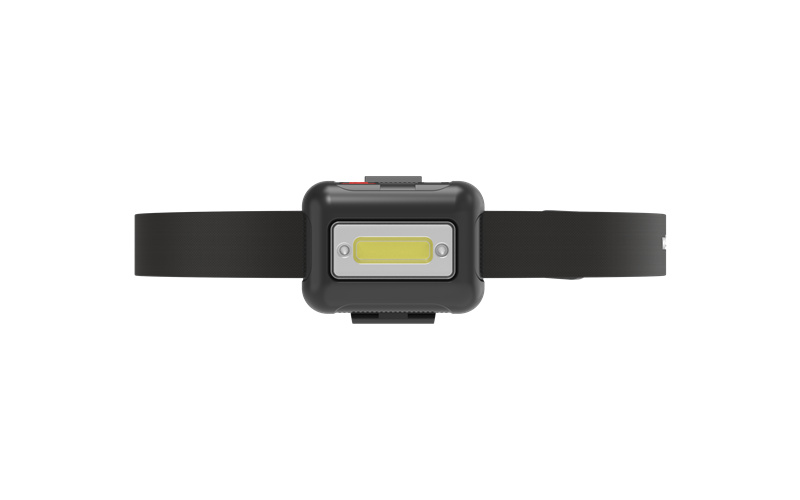
The transition from mechanical switches to optical sensors represents a significant advancement in personal lighting. Understanding the underlying mechanics helps clarify why these devices offer superior reliability in demanding environments.
Most professional-grade units utilize active infrared technology. The device features two primary components mounted on the side of the chassis—an infrared emitter and an infrared receiver.
The emitter continuously projects a low-power, invisible beam of infrared light outward. When a solid object passes within the calibrated detection zone, typically 10 to 15 centimeters, the object reflects the light back toward the receiver. The internal microprocessor instantly registers this reflection and toggles the primary LED circuit. This localized calibration ensures the light responds only to deliberate hand waves rather than passing environmental objects.
Beyond basic convenience, a Hands-Free Headlight actively shapes safer ergonomic behaviors. Managing tools, maintaining balance, and analyzing a mechanical problem demand a high cognitive load.
When lighting adjustments become entirely frictionless, operators no longer divert mental or physical resources away from the primary task. This seamless integration encourages continuous focus. Workers are far less likely to settle for inadequate lighting, which is a common cause of errors and injuries, simply because optimizing visibility requires zero physical effort.
To truly understand the operational impact, we must look at how traditional switches compare to motion-activated systems across key performance metrics on the job site.
Performance Metric | Traditional Push-Button | Motion Sensor System |
|---|---|---|
Glove Compatibility | Poor. Requires removing thick gloves to feel the switch. | Excellent. Detects the wave of any glove material instantly. |
Cross-Contamination Risk | High. Transfers grease and chemicals directly to the face and gear. | Zero. Completely touchless operation maintains hygiene. |
Hardware Lifespan | Shorter. Mechanical switches fail due to dirt ingress and friction. | Longer. Solid-state optical sensors eliminate moving parts. |
Task Interruption | High. Forces users to stop working and drop tools to adjust light. | Minimal. A quick wave allows continuous workflow. |
Not all optical lighting solutions meet industrial standards. When selecting equipment for rigorous applications, specific technical specifications must be evaluated to ensure reliable performance.
Traditional directional LEDs are excellent for long-distance spotting. However, they create a narrow, intense beam that causes severe eye fatigue during up-close tasks.
To combat this, integrating a COB Headlamp design is essential. Chip-on-Board technology features multiple LED chips packaged tightly together as a single lighting module. This produces a highly uniform, ultra-wide floodlight effect, often covering a 230-degree field of view. For a mechanic working under a vehicle chassis, this illuminates the entire peripheral vision without harsh hotspots, drastically reducing optical strain.
An optical sensor is only useful if the internal circuitry survives the environment. The Ingress Protection rating is a critical metric for any professional tool.
For dirty or wet conditions, an IP54 rating is the baseline standard, offering resistance to dust and splashing water. In contrast, environments involving heavy drywall powder or torrential rain demand an IP65 rating. The first digit indicates total protection against dust ingress, while the second digit signifies resistance to low-pressure water jets, allowing the unit to be rinsed clean at the end of a shift.
Operational requirements change dynamically throughout the day. A high-quality unit should offer versatile output options that work in tandem with the motion sensor. Essential modes include a high-lumen spotlight for inspecting deep cavities, a wide floodlight for general workspace illumination, and a low-output mode to conserve battery life during extended shifts.
Empirical observation across various trades demonstrates how motion-activated lighting solves specific industry pain points.
Picture a technician wedged beneath a dripping oil pan, wearing nitrile gloves slick with 10W-40 oil. Engine bays are cramped and notoriously poorly lit. Reaching up to click a tiny plastic button smears corrosive fluids directly onto the lens. Waving a greasy hand to activate a broad light prevents this transfer, keeping the workspace illuminated and the equipment intact.
Wrestling with a stubborn pipe wrench in a dark, unfinished basement demands full concentration. Navigating these spaces often requires crawling on hands and knees. When hands are covered in pipe dope, mud, or raw sewage, a hands-free sensor allows technicians to control visibility without smearing biological or chemical debris across their foreheads.
For outdoor crews, weather dictates operational protocols. In freezing conditions, removing thermal gloves to click a frozen button exposes workers to frostbite risks and plummets productivity. Motion sensors are calibrated to detect the bulk of a winter glove just as easily as a bare hand, preserving precious body heat.
Surface preparation requires meticulous attention to detail. Wet paint, primer, and drywall dust are notorious for ruining delicate electronics. A wave-to-activate system ensures that sticky residues remain strictly on the brush or roller, keeping the headlamp pristine and fully functional for future projects.
The power source of a headlamp dictates its reliability, operating cost, and environmental footprint. The industry shift toward integrated lithium-ion batteries is driven by measurable economic and functional advantages.
Traditional lighting relies on constant replacements of alkaline batteries. In a professional setting where a light operates for up to eight hours daily, the recurring cost of disposable batteries quickly surpasses the initial purchase price of the tool itself.
Upgrading to a Rechargeable Head Lamp offers a superior return on investment. Lithium-ion cells maintain a consistent voltage output, meaning the light remains bright until the battery is nearly depleted. Over a standard operational lifespan of 500 charge cycles, a rechargeable unit eliminates the procurement, storage, and disposal costs associated with hundreds of single-use batteries.
Innovation in power delivery continues to streamline workflow. The introduction of the Wireless Charging Headlight eliminates one of the final friction points of device management—damaged charging ports.
In environments heavy with metallic dust or moisture, standard USB-C ports clog or corrode easily, even with rubber covers. Inductive wireless charging allows operators to simply place the device on a designated magnetic pad at the end of their shift. This completely sealed power transfer method removes fragile physical connection points, further enhancing resistance to dirt and moisture.
While these devices are explicitly engineered to mitigate dirt transfer, routine maintenance ensures optimal sensor calibration and device longevity.
The wave-to-activate feature relies on optical clarity. If the side sensors become heavily caked with mud or opaque grease, the device may fail to register a hand wave. Wipe the sensor area gently with a damp microfiber cloth. Avoid abrasive sponges or harsh chemical solvents like acetone, which permanently cloud the polycarbonate sensor lens.
Elastic headbands act like sponges, absorbing sweat, skin oils, and atmospheric dirt. Over time, this degrades the elasticity and harbors bacteria. Always detach the electronic housing first, then hand wash the strap periodically in warm, soapy water. Allow it to air dry completely. Never use a mechanical dryer, as high heat destroys elastic fibers.
To maximize the lifespan of lithium-ion cells, avoid completely draining the battery on a daily basis. Recharging when it reaches 20% capacity helps maintain chemical health. If the unit will be stored for an extended period, keep it in a climate-controlled environment charged to approximately 50%. Extreme freezing or baking temperatures severely degrade battery chemistry.
Relying on outdated lighting technology in messy, demanding environments is a handicap to both safety and efficiency. By embracing motion-sensor technology, professionals eliminate the frustrating cycle of removing gloves, fumbling for switches, and ruining equipment with grime. Evaluate your current site requirements and explore the professional-grade solutions at WiseTech Lighting to find the exact configuration your team needs. Upgrading to a modern, touchless lighting solution ensures that your focus remains exactly where it belongs—on completing the task at hand safely and effectively.
Most high-quality motion sensors are specifically calibrated to detect movement within a very narrow, close range, typically between 10 to 15 centimeters from the device. This short-range calibration is intentionally designed to prevent false triggers from passing walls, low-hanging branches, or machinery. The sensor requires a deliberate wave in close proximity to activate the switch.
Yes. The vast majority of professional-grade units feature a manual override system. Users can press a physical button to disable the infrared sensor entirely, allowing the device to function exactly like a standard push-button light. This is particularly useful in highly confined spaces, such as deep inside a dashboard, where involuntary close-range movements are unavoidable.
Runtime varies significantly based on the battery capacity and the selected brightness mode. Generally, a professional unit provides between 3 to 8 hours of continuous illumination on a high setting, and up to 20 hours on lower energy-saving settings. Modern devices utilize fast-charging technology, allowing them to reach a full charge in approximately 2 to 4 hours.
For close-up, detailed tasks like automotive repair or electrical wiring, wide-angle floodlight technology is vastly superior. Traditional spotlights produce a focused, intense beam that creates harsh glare and deep shadows, rapidly causing eye strain. A wide-angle design provides a smooth, even wash of light that illuminates your entire field of vision without blinding hotspots, making it the optimal choice for precision diagnostics.
The infrared optical sensor itself is highly resilient to cold temperatures and will continue to detect motion accurately. However, extreme cold can temporarily reduce the efficiency of the lithium-ion battery powering the device. High-quality professional headlamps are engineered to operate effectively in sub-zero conditions, though users may experience slightly reduced total runtimes during severe winter weather.
Yes, on most advanced models, the motion sensor works in tandem with the manual brightness controls. You typically use the physical button to select your desired output mode—such as high flood, low flood, or spot—and then activate the sensor mode. From that point on, waving your hand will toggle the light on and off at that specific, pre-selected brightness level.

