


Views: 0 Author: Site Editor Publish Time: 2026-09-05 Origin: Site


Managing power budgets on a job site or inside a workshop demands strict attention. Running multiple heavy-duty tools off a single generator or breaker leaves little room for error. Overloaded circuits quickly halt productivity and create hazardous conditions.
We have seen a massive shift from legacy halogen fixtures to modern LED technology. This change delivers a drastic reduction in power draw for high-visibility applications. You no longer need to sacrifice tool capacity just to see your workspace clearly. LEDs solve this historic problem seamlessly.
This article serves as your comprehensive evaluation guide. We will provide precise power calculations to help you manage site resources effectively. You will also learn how to evaluate the commercial viability of various form factors. Finally, we offer a practical decision framework for selecting a high-lumen fixture tailored to your specific environment.
Direct Conversion: A true 10,000-lumen LED work light typically draws between 70 to 100 watts, assuming an average LED efficacy of 100–150 lumens per watt.
Legacy Comparison: To achieve the same 10,000-lumen output, a traditional halogen work light requires roughly 500 to 1000 watts.
Power Budgeting: At 100 watts, a standard 15-amp, 120-volt circuit can safely run up to 14 of these LED lights (factoring in the 80% continuous load rule), leaving ample capacity for power tools.
Form Factor Reality: Because a 100-watt draw drains batteries rapidly, true 10,000-lumen models are predominantly corded or require high-capacity, professional-grade battery packs.
Job site power remains a finite and precious resource. Every contractor understands this operational reality. Overloading circuits causes immediate downtime on the floor. It trips essential breakers and can severely damage sensitive equipment. You must manage power distribution carefully to maintain workflow.
To understand LED power consumption, we must clarify the LED efficacy formula. Watts simply measure energy consumption. They do not measure actual brightness. Lumens dictate the visible brightness you experience. Commercial-grade LEDs feature an average efficacy of 100 to 150 lumens per watt. Therefore, a fixture outputting 10,000 lumens generally consumes around 100 watts of power.
This low wattage dramatically simplifies generator and circuit load calculations.
Generator Impact: A standard 2000W portable inverter generator easily accommodates this demand. Running a 100W light only consumes 5% of its total capacity. You retain massive power reserves for saws, drills, and air compressors.
Circuit Load Efficiency: A standard 15-amp, 120V circuit handles 1800 watts continuously. Following the 80% safety rule, you have a 1440-watt working threshold. A 100W light barely impacts this budget.
When you deploy a High Lumen LED Work Light, extension cord requirements drop significantly. You can use a practical formula to calculate cord gauge needs: Amps equal Watts divided by Volts. In this case, 100W divided by 120V equals just 0.83 Amps.
Because the amp draw is incredibly low, you can safely run a standard 16-gauge or 14-gauge extension cord over 100 feet. You will not experience the dangerous voltage drops typically associated with heavy halogen loads. This flexibility keeps your site safe and illuminated without requiring heavy, cumbersome commercial cables.
When choosing a lighting solution, comparing the operational penalties of older technologies is crucial. Halogen fixtures once dominated job sites. However, they carry significant operational burdens. LEDs eliminate most of these frustrating performance bottlenecks.
Thermal management defines a core safety difference between these solution categories. A traditional 1000W halogen produces severe heat output. It projects intense thermal energy forward. This creates immediate fire hazards if placed near combustible materials. It also poses severe burn risks for workers operating in tight spaces. Conversely, a 100W LED utilizes an advanced aluminum heat sink. It manages heat efficiently at the rear of the unit. The housing stays warm but rarely becomes dangerously hot to the touch.
Durability issues also plague legacy fixtures. Halogen bulbs rely on fragile internal filaments. Job site vibrations from heavy machinery or simple accidental kicks easily snap these filaments. They require constant, frustrating replacements. Modern solid-state LED diodes contain no fragile glass or moving parts. They typically boast operational ratings of 30,000 to 50,000 hours. They survive rough handling and chaotic environments effortlessly.
Scalability improves drastically with LED technology. The lower wattage of modern diodes allows for extensive daisy-chaining. You can string multiple lights across a larger work area using a single power source. You never need to upgrade your primary power infrastructure to accommodate basic illumination.
Job Site Lighting Operational Comparison
Performance Metric | 1000W Halogen Fixture | 100W LED Fixture |
|---|---|---|
Lumen Output | ~10,000 Lumens | ~10,000 Lumens |
Amp Draw (120V) | 8.33 Amps | 0.83 Amps |
Heat Generation | Severe (Fire Hazard) | Low (Managed via Heat Sink) |
Vibration Resistance | Very Poor (Fragile Filament) | Excellent (Solid-State) |
Estimated Lifespan | 1,000 - 2,000 Hours | 30,000 - 50,000 Hours |
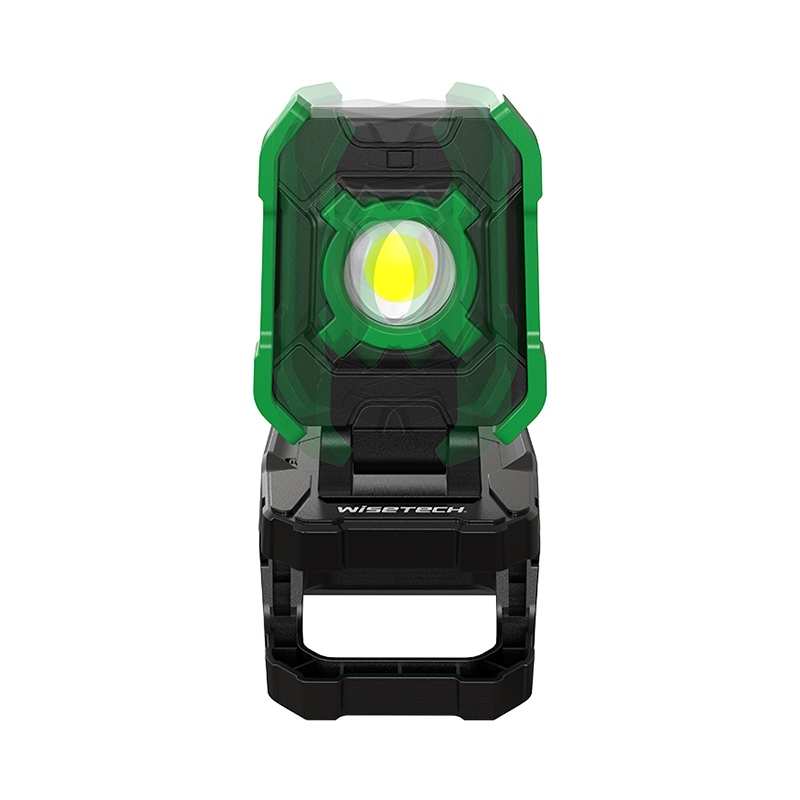
Choosing the right form factor guarantees optimal light delivery. Different commercial applications require distinct configurations. You must evaluate the physical design of the fixture to ensure it meets your environmental demands.
Dual-head tripod models stand out for directional flexibility. You can articulate the light heads independently. This allows you to illuminate two distinct workspaces simultaneously. However, you must address specific implementation risks. Tripod stability on uneven ground is a major concern. Look for wide leg bases and sturdy locking mechanisms. Maximum height also matters deeply. A tripod that extends to 68 inches or more effectively reduces eye-level glare. It casts light downward, mimicking natural room lighting.
360-degree and retractable area lights serve a completely different purpose. They work best for central room placement. Contractors highly value them for drywall installation, taping, and room painting. You must understand the trade-off here. These models provide diffused omnidirectional light. They eliminate shadows beautifully. However, they lack the intense, focused beam needed for specific, detailed task lighting.
Finally, you must confront rechargeable versus corded realities. This is a critical trust check for equipment buyers. Battery-powered 10,000-lumen fixtures sound incredibly convenient. Yet, physics dictates strict limitations. A continuous 100-watt draw depletes a standard 5Ah tool battery (18V/20V) in under an hour. While cordless models offer short bursts of extreme brightness, sustained high-output operations demand consistent power. Establishing a reliable, continuous 10K lumen output typically requires a corded AC connection. Keep this reality in mind before committing entirely to battery-operated systems.
Raw brightness alone does not guarantee a successful lighting setup. You must evaluate secondary technical specifications carefully. These criteria dictate how comfortable and reliable the fixture will be during long shifts.
Color Temperature (Kelvin): The industry standard for a professional Work Light is 5000K (Daylight). It provides extremely high contrast for precision mechanical work and accurate color matching. It effectively avoids the harsh, fatigue-inducing blue glare associated with 6000K+ lights.
Dimmability and Power Stepping: This remains a critical feature for maximizing overall utility. You rarely need a full 10,000 lumens in a small closet or under a vehicle. The ability to step the power down to 5,000 or 2,500 lumens saves energy. It also drastically reduces painful eye strain in enclosed, reflective spaces.
Ingress Protection (IP Rating): You must establish baseline compliance standards for environmental survival. A minimum rating of IP65 is strictly required for outdoor job sites. This rating ensures the internal components remain protected against fine dust particles. It also defends against low-pressure water jets and sudden rainstorms.
Build Quality and Heat Sinks: You must watch out for dangerously cheap models. Many unverified brands claim a 10,000-lumen output without integrating adequate aluminum heat dissipation. Heavy heat buildup leads to immediate thermal throttling. The light actively dims itself to survive. Eventually, it causes premature diode failure entirely.
Your shortlisting logic should rely on clearly defined success criteria. You must assess the actual area of illumination you need to cover daily. As a baseline rule, a true 10,000-lumen output is exceptionally bright. It is generally sufficient to brightly light a standard two-car garage. It easily illuminates a 500-square-foot room perfectly for detailed finishing work.
Vendor transparency serves as your best defense against exaggerated claims. We highly recommend rejecting products that boast incredible numbers without logical specs. If a vendor advertises 10,000 lumens but lists a power draw of only 20W or 30W, walk away. This claim is mathematically impossible with current LED technology. Protect your site safety by insisting on verifiable, mathematically sound specifications.
Your next-step actions should be highly practical. First, inventory your available power sources. Determine your typical portable generator size. Confirm standard AC availability on your average site. Second, select your required form factor before browsing. Decide whether a tall tripod or a rugged floor stand suits your workflow best. This systematic approach ensures you purchase a tool that actually improves your site efficiency.
A true 10,000-lumen LED fixture is a high-efficiency tool that typically draws around 100 watts of power. It fundamentally changes how we manage electricity on active job sites. It frees up vital circuit capacity for heavy machinery while providing daylight-level illumination.
While LEDs completely solve the extreme power-draw problem of traditional halogen lighting, you must remain vigilant. Buyers must rigorously evaluate build quality, IP ratings, and accurate performance claims. Not all fixtures survive the chaotic environment of a commercial workspace. You need heavy-duty materials and proper thermal management to ensure job site reliability.
Before finalizing any purchase, always review the official spec sheets. Check for the actual wattage draw to verify lumen claims. Ensure the unit features a robust aluminum heat sink. By demanding transparency, you guarantee your site stays brightly lit, safe, and highly productive for years to come.
A: Yes, but only for a very short duration. Drawing ~100 watts means a standard 5Ah/18V power tool battery (90 Watt-hours) will last less than an hour at maximum brightness. Most 10,000-lumen lights use AC power.
A: Yes, but not dangerously so like a halogen. A 100-watt LED produces heat at the back of the unit (the heat sink) rather than projecting it forward. The housing may be warm to the touch, but it will not cause instant burns or pose a severe fire hazard.
A: Because 100 watts pulls less than 1 amp at 120V, a standard 16-gauge or 14-gauge extension cord is more than sufficient, even at lengths up to 100 feet, without experiencing significant voltage drop.
A: 5000K simulates natural daylight, offering crisp contrast ideal for detailed mechanical work or painting. 4000K is slightly warmer and easier on the eyes, often preferred for general ambient lighting but less precise for color-matching tasks.

