


Views: 0 Author: Site Editor Publish Time: 2026-09-11 Origin: Site


Job site lighting is rarely seen as a critical operational variable. Many professionals treat it as a generic utility. Yet, illumination directly controls workflow speed. It dictates precision levels. It fundamentally drives error reduction on complex projects.
We are witnessing a major shift in the industry. Traditional halogen units are fading out. Corded setups are becoming obsolete. Modern LED technology sets a completely new baseline. True mobility fundamentally alters how teams tackle challenging tasks. Tethers and power constraints no longer dictate site movement.
Evaluating this new technology requires looking past surface-level brightness. You must understand how proper illumination impacts safety. You need to measure its effect on task speed. We will explore these hidden operational multipliers. You will learn to navigate aggressive marketing claims. By the end, you can choose equipment that drives genuine, measurable productivity.
Hands-Free Mobility: Cordless designs eliminate setup/teardown time and reduce trip hazards, directly increasing active tool time.
Ergonomic & Cognitive Impact: High-CRI LED lighting reduces eye strain and fatigue, directly correlating to lower error rates in precision tasks.
True Cost of Ownership: While upfront costs are higher, rechargeable units mitigate power consumption, bulb replacement, and downtime.
Spec Reality Check: Max lumens matter less than sustained runtime, beam distribution, and robust mounting options (magnets/hooks).
Adequate illumination directly controls task accuracy. Poor lighting forces the eyes to strain. Eye muscles work overtime to focus. This leads to physical fatigue. Fatigue quickly causes cognitive errors. Proper color temperature changes this dynamic entirely. The ergonomic baseline sits between 5000K and 6000K. This range closely mimics natural daylight. Daylight spectrums suppress melatonin production in the brain. Melatonin makes humans feel sleepy. Suppressing it maintains operator alertness. Alert workers make fewer mistakes. They work faster. They sustain concentration over longer shifts. A well-lit workspace is an active performance multiplier.
Color Rendering Index (CRI) measures how accurately a light reveals true colors. Sunlight scores 100 on this scale. Professional trades require a CRI above 80. This metric is absolutely non-negotiable. Electricians rely on it for wiring identification. Confusing a red wire for a brown one causes catastrophic failures. Automotive technicians need high CRI for paint matching. Plumbers use it to spot subtle chemical leaks. Low-quality LEDs wash out colors. They make everything look gray or blue. High CRI prevents costly rework. Getting the job done right the first time depends on seeing it correctly.
Corded lights create massive operational drag. We call this "cord friction." Think about the daily routine. Workers spend time unspooling long cables. They hunt for available power outlets. They drag extension cords across complex job sites. Moving a tethered light takes two minutes. Doing this ten times a day wastes twenty minutes. Across a crew of five, you lose hours of weekly productivity. Cordless designs eliminate this entirely. A worker grabs the light. They place it instantly. Active tool time increases immediately. The physical burden of cable management disappears.
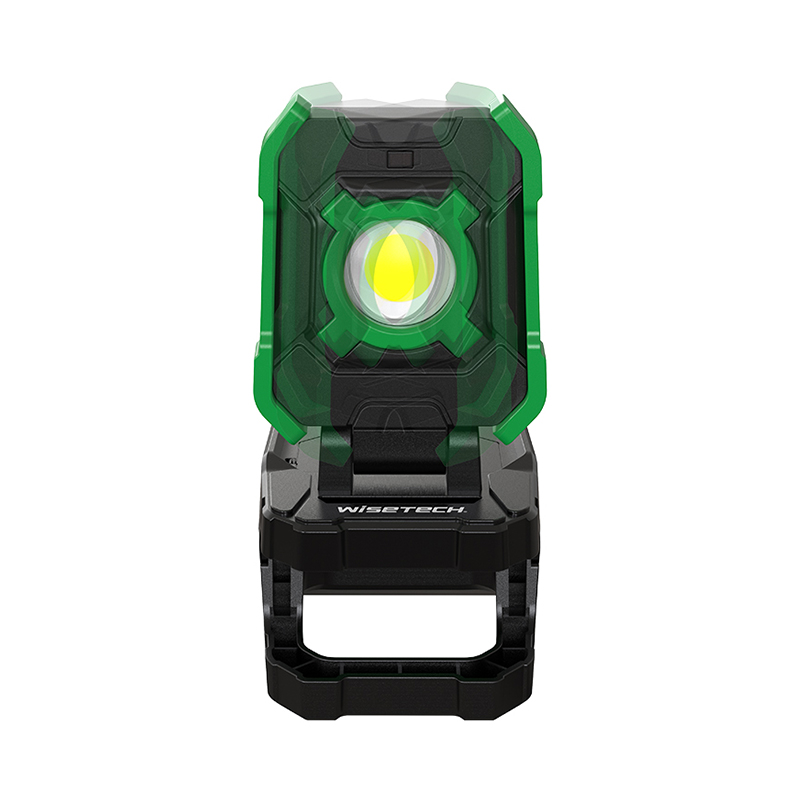
Extension cords snake across scaffolding. They drape over walkways. They clutter tight corridors. These cords create severe safety liabilities. Removing them is a primary method for risk reduction. OSHA consistently classifies slips, trips, and falls among top workplace incidents. Going cordless removes the hazard entirely. Workers move freely without watching their feet. Safety managers prefer battery-operated tools for this exact reason. Eliminating physical cables shrinks the accident profile of any construction site.
Legacy halogen lights generate extreme heat. Their lenses routinely surpass 500 degrees Fahrenheit. Touching them causes instant third-degree burns. Placing them near combustible materials creates severe fire risks. Enclosed spaces amplify this danger. Modern LED technology runs remarkably cool. You can touch the lens after hours of operation. Cool-running fixtures protect workers in tight spaces. They do not heat up small rooms. They do not require cool-down periods before packing up. This thermal safety allows for faster, safer job site breakdowns.
Certain industries require specialized safety gear. Chemical plants are highly volatile. Refineries contain explosive gases. Grain silos hold combustible dust. Standard electronics pose an ignition risk in these zones. A simple battery spark can trigger an explosion. Specialized environments demand Intrinsically Safe (IS) ratings. IS-rated equipment prevents electrical sparks. Standard battery-operated lights do not meet this standard. Always verify IS compliance before entering hazardous zones. Proper certification prevents catastrophic industrial accidents.
Manufacturers love the "lumen race." They advertise massive brightness numbers. You must approach these claims carefully. Lumens measure total light output. Lux measures light hitting a specific surface. Usable light matters far more than raw output. A highly concentrated hotspot causes severe glare. Glare bounces off metallic surfaces. It blinds the operator. A wide, even flood beam is vastly superior. It illuminates the entire workspace smoothly. It eliminates harsh shadows. Stop chasing maximum lumens. Focus on beam distribution. A well-distributed 1000-lumen light outperforms a harsh 3000-lumen spotlight.
Table 1: Lumens vs. Lux in Practical Application
Metric | What It Measures | Practical Job Site Meaning |
|---|---|---|
Lumens | Total raw light emitted | Overall power capability of the LED chip. |
Lux | Light density on a surface | How well you can actually see the task. |
Hotspot Beam | Concentrated center light | Good for distance, terrible for close-up tasks. |
Flood Beam | Wide, even dispersion | Ideal for general workspaces and avoiding glare. |
Lithium-Ion chemistry rules the modern cordless market. However, you must understand battery degradation. Batteries have limited charge cycles. Most premium units deliver 500 to 1000 full cycles. After this, capacity drops noticeably. USB-C standardization is highly recommended. It reduces the number of unique chargers you carry. Pass-through charging is another critical feature. This allows you to use the light while it is plugged into a power source. Not all models support this. Without pass-through charging, a dead battery stops work completely. Verify this feature for continuous-shift environments.
Professional environments destroy fragile equipment. You must verify durability ratings independently. The Ingress Protection (IP) rating measures dust and water resistance. We recommend a strict minimum of IP65. This ensures complete protection against dust. It also withstands low-pressure water jets. The Impact Protection (IK) rating is equally crucial. It verifies drop-test claims. An IK07 or IK08 rating indicates robust housing. It survives typical falls onto concrete. Never trust vague "heavy-duty" marketing language. Always demand specific IP and IK testing numbers.
Chart 1: Standard Durability Benchmark Guide
Rating Type | Minimum Recommended | What It Protects Against |
|---|---|---|
IP54 | Not Recommended | Light splashes only. Vulnerable to heavy dust. |
IP65 | Minimum Standard | Complete dust seal. Withstands direct water spray. |
IK07 | Minimum Standard | Survives standard waist-height drops. |
IK08 | Ideal Choice | Survives heavy impacts and rough transport. |
Mounting versatility acts as a direct productivity multiplier. If a worker holds a tool, they lose a hand. Working one-handed cuts efficiency in half. It compromises balance. It increases the risk of slipping. True hands-free operation requires versatile mounting options. The light must attach to various surfaces effortlessly. A reliable Work Light adapts to the environment. It never forces the environment to adapt to it. This adaptability separates professional gear from consumer toys.
Real-world usability depends heavily on mounting hardware. Rare-earth magnets are incredibly strong. They lock onto steel beams securely. However, raw magnets scratch painted surfaces. Trade professionals demand rubberized magnetic bases. This protects sensitive finishes on automotive panels or finished HVAC units. Non-ferrous environments present a different challenge. Aluminum studs and wooden joists reject magnets. Here, you need aggressive clamping mechanisms. A Rechargeable Work Light featuring heavy-duty clamps grabs onto scaffolding pipes easily. It bites onto 2x4 framing lumber. It ensures stability regardless of the material.
Job sites feature complex geometries. Light rarely needs to shine straight ahead. Articulating heads solve this geometric problem. Multi-axis rotation allows precise directional control. You can angle the beam upward into a ceiling cavity. You can tilt it downward into an engine bay. You achieve this without repositioning the entire base unit. Stiff, fixed fixtures waste time. Workers constantly adjust the base trying to find the perfect angle. Fluid articulation saves minutes on every setup.
Financial decisions require looking past the initial purchase price. Premium cordless options carry higher upfront price tags. Corded halogens look cheaper on paper. However, lifecycle costs tell a completely different story. Halogen bulbs break constantly during transport. Replacements add up quickly. Power consumption draws heavily on site generators. More importantly, setup time costs expensive labor hours. When you factor in bulb replacements, power usage, and time lost to cable management, cordless units win easily. They pay for themselves through recovered labor efficiency.
Buyers often make mistakes during the shortlisting phase. They filter options by maximum lumens. They buy based on high-output runtimes. This is a flawed strategy. Manufacturers engineer lights to step down. A 3000-lumen light might throttle down to 1000 lumens after ten minutes. This prevents severe overheating. You should match the light's medium-setting runtime to your average continuous task duration. The medium setting represents the true sustained capability. It avoids thermal throttling. It provides reliable, consistent output for hours.
Making a smart purchase requires a systematic approach. Follow these actionable steps to standardize your equipment:
Audit your current setup time. Calculate the daily minutes lost to cord management.
Identify your primary surface types. Determine if you need magnets, clamps, or tripods.
Standardize battery platforms. Buying for a fleet means minimizing different charger types.
Prioritize hybrid models. Look for units combining built-in batteries with direct wall-plug capabilities.
Verify thermal management. Ensure the housing effectively dissipates heat during high-output modes.
Hybrid models offer maximum flexibility. They run on batteries when mobility matters. They run on wall power during stationary, all-day tasks. This flexibility guarantees zero downtime.
Upgrading illumination represents a direct investment in human performance. It is not just another equipment line item.
Proper color temperature and high CRI directly reduce costly cognitive and physical errors.
Removing cords eliminates major safety liabilities while reclaiming lost labor hours.
Usable lux, sustained medium-mode runtimes, and versatile mounting outrank peak lumen claims.
The best equipment integrates seamlessly into your daily workflow. It never introduces new limitations. You should not trade cord friction for constant battery anxiety. You should not trade heat hazards for fragile plastic components. High-quality lighting works quietly in the background. It allows professionals to focus entirely on their craft. Take time this week to audit your current job site lighting bottlenecks. Compare your daily frustrations against modern cordless solutions. The efficiency gains will surprise you.
A: Runtime varies drastically based on output modes. You can realistically expect 2 to 4 hours on the highest setting. Low or medium settings typically yield 8 to 12 hours. Always factor in thermal step-down features, which automatically reduce brightness to preserve battery life and prevent overheating.
A: Yes, if the unit features "pass-through charging." This allows the light to operate directly from wall power while simultaneously charging the battery. Not all models support this function. It is a critical specification to verify for continuous-shift environments.
A: Pragmatic benchmarks vary by task. Close automotive or electrical work requires 500 to 1000 lumens. Illuminating an entire room or outdoor staging area demands 3000+ lumens. Beware of over-illumination. Using too many lumens in tight spaces causes severe, blinding glare.

