


Views: 0 Author: Site Editor Publish Time: 2026-11-15 Origin: Site


Is your job site lighting holding your crew back? Poor visibility does not just slow down progress; it leads to costly rework, compromised safety, and frustrating inspection failures. I have spent years on active construction sites, and I can tell you firsthand that illumination is a critical productivity tool, not just a basic utility. Professional contractors are finally ditching outdated halogen setups for advanced LED solutions. However, choosing the right gear requires understanding the specific technical benefits of modern lighting. This guide breaks down exactly which professional tools suit your trade needs, helping you select the right equipment to keep your crew operating at peak efficiency.
Color Temperature Basics: Kelvin ratings directly dictate visual clarity, eye fatigue, and task accuracy on the job.
Fixed vs. Adjustable: Some professionals demand the bulletproof reliability of fixed models, while multi-trade crews require the dynamic versatility of adjustable color temperatures.
Context Matters: Specific jobs require crisp Daylight spectrums, whereas dusty demolition sites demand softer Warm White illumination to cut through airborne particles.
Power Considerations: Your choice between grid power and battery packs dictates your operational capabilities on remote sites.
Expert Recommendation: Use our technical breakdown to procure the exact gear your team needs to reduce errors and speed up workflows.
Correlated Color Temperature, commonly referred to as CCT, is a foundational measurement in the commercial lighting industry. Measured on the Kelvin scale, it describes the visual color appearance of the light emitted by an LED diode. Brightness is measured in lumens and dictates how far your light reaches. CCT, on the other hand, dictates the functional clarity of your workspace.
The spectrum spans three main functional categories. Warm White ranges from 2700 to 3000 Kelvin and emits a soft amber glow. Moving up the scale, Neutral White at 4000 Kelvin provides a balanced illumination mimicking natural morning sunshine. This specific range significantly reduces eye strain during grueling twelve-hour shifts. Finally, Cool or Daylight settings between 5000 and 6500 Kelvin produce a crisp, blue-tinted beam that maximizes contrast for absolute precision.
For professional contractors, selecting a color spectrum is never a matter of aesthetic preference. It is a highly functional technical decision. The wrong spectrum will severely distort color perception. A poor lighting choice might mask subtle flaws during drywall mudding or completely fail to highlight hairline cracks during mechanical inspections.
A fixed CCT LED work light is factory-calibrated to emit a single, unchangeable color temperature. Most commercial units are set at a highly visible 5000 or 6500 Kelvin. Manufacturers engineer these units for absolute consistency and structural simplicity.
The primary advantage of a single-spectrum model is its rugged, no-nonsense durability. By stripping out complex internal dimmers and secondary circuit boards, engineers eliminate potential points of failure. This streamlined internal architecture makes these lights exceptionally well-suited for high-impact environments where gear takes a daily beating. They are also generally more cost-effective to manufacture. This offers a lower entry price when you need to outfit a large crew of fifty workers. You get the exact same reliable light quality every single time you flip that heavy-duty switch.
In contrast, their main drawback is operational rigidity. You simply cannot switch temperatures if your task requirements abruptly change. If your crew transitions from rough framing in a dusty basement to precision trim carpentry in a finished room, a fixed light cannot adapt. Therefore, deploy these units in trades where lighting requirements remain static, such as heavy demolition, concrete pouring, or general ambient site illumination.
Adjustable models feature integrated solid-state controllers that allow operators to seamlessly toggle between multiple Kelvin settings. This adaptability is fundamentally changing how site managers plan their temporary power and lighting layouts.
Professionals frequently juggle multiple tasks within a single shift. You might start your morning pulling electrical wire. Here, a high-contrast cool light is absolutely necessary to distinguish faded color codes in a dark utility closet. Later in the afternoon, you may transition to interior painting. Switching the light to a 4000 Kelvin setting reveals brush strokes and surface textures without the harsh, blinding reflections caused by cooler blue light. One adjustable unit acts as three different specialized tools, adapting instantly to your changing environment.
While the versatility and enhanced eye comfort are undeniable advantages, there is a minor trade-off in design. The additional electronic components slightly increase the internal complexity of the unit. However, modern engineering has largely mitigated these concerns. Commercial-grade membrane switches ensure that the convenience of tuning your light does not lead to a catastrophic failure on the job site.
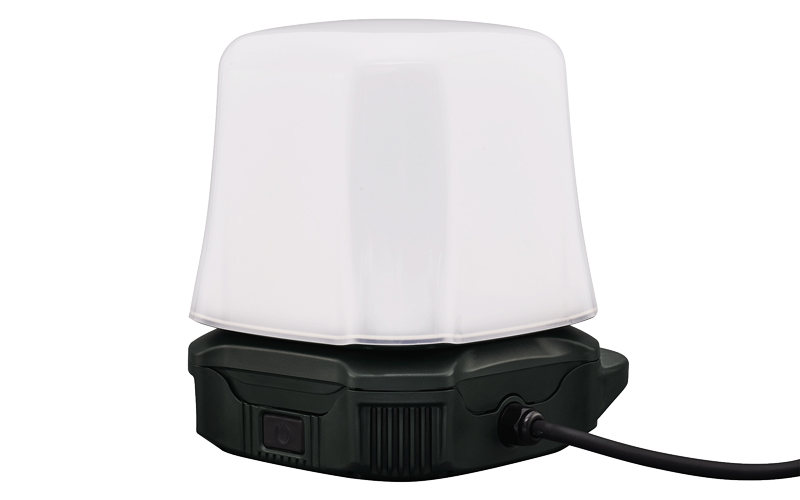
Selecting the right power source is just as critical as dialing in your ideal color temperature. The AC portable work light remains the undisputed backbone of the heavy construction industry. High-output area lights, such as 47-watt to 80-watt 360-degree LED towers, draw significant continuous power. Because these units pull limitless energy directly from the grid or a gas generator, they easily house robust circuitry that supports adjustable CCT functions without any risk of flickering or performance drops.
Conversely, a rechargeable DC work light provides the ultimate freedom to navigate a site without tripping over heavy extension cords. When selecting a battery-powered model, you must ensure the adjustable CCT feature is energy-efficient. Budget-tier models often experience noticeable dimming or color drift as the lithium-ion battery reaches its final twenty percent capacity. Modern high-end DC lights utilize advanced battery management systems to lock in the exact color temperature from the first minute of operation to the last.
Procurement decisions in the professional trades must be grounded in an objective analysis of efficiency and long-term utility. Looking at current industry trends, there is a pronounced shift toward smart, adaptive site illumination. General contractors are moving away from renting single-function tower lights. Instead, recent market analyses indicate a growing preference for versatile lighting ecosystems that reduce the overall equipment footprint on a crowded site. As construction schedules tighten and multi-trade overlap becomes the norm, equipment that serves multiple roles without requiring additional power infrastructure is highly valued.
From a financial perspective, a standard fixed-spectrum model requires a lower initial investment. For specialized trades performing repetitive tasks in consistent environments, this lower upfront cost makes the fixed model a highly efficient purchase. However, for facility maintenance teams and multi-disciplinary crews, those initial savings evaporate quickly when changing project scopes force the purchase of supplementary lamps.
The strongest financial argument for adjustable technology is equipment consolidation. Instead of hauling a warm light for concrete work, a neutral light for ambient illumination, and a daylight lamp for detailed inspection, a single adjustable unit fulfills all three roles seamlessly. This consolidation dramatically lowers the Total Cost of Ownership over the lifespan of the equipment.
Feature | Fixed CCT Work Lights | Adjustable CCT Work Lights |
|---|---|---|
Internal Complexity | Low. Single driver, fewer failure points. | Moderate. Requires dual-channel drivers and controllers. |
Best Application | Dedicated tasks, heavy demolition, rough framing. | Multi-trade sites, finishing work, electrical inspection. |
Upfront Cost | Lower entry price. | Slightly higher initial investment. |
Long-Term ROI | High for single-trade crews. | Excellent for general contractors due to tool consolidation. |
Choosing the correct color temperature is a strict technical requirement dictated by your physical environment. Different trades encounter unique visual challenges that demand targeted lighting spectrums to guarantee safety and workflow efficiency. Here is how to standardize your selection.
Painting and Finishing: The Need for True Color Representation
For painters, drywallers, and finishing carpenters, visual accuracy is everything. You must evaluate color consistency, seamless blending, and microscopic surface imperfections. A fixed model set to a warm temperature will cast a heavy yellow hue over the wall. This masks true colors and leads to mismatched paint batches or highly visible drywall seams once the room is exposed to natural daylight. To avoid this, professionals require a Daylight spectrum between 5000 and 6500 Kelvin. This ensures that indoor finishes look identical when bathed in actual sunlight.
Electrical and Mechanical: High Contrast for Technical Details
Imagine an HVAC technician working in a confined, greasy engine bay. The primary visual hurdle is a lack of contrast. Technicians must differentiate between tightly bundled, color-coded wires in heavy shadows. A higher Kelvin rating, typically hovering between 4000 and 5000 Kelvin, provides a crisp white beam that sharpens contrast and enhances edge definition. This actively stimulates visual acuity, making it significantly easier to read fine print on mechanical relays.
General Construction: Balancing Visibility and Glare Reduction
Active job sites are frequently choked with airborne particulate matter, including sawdust, pulverized concrete, and drywall powder. When a highly intense 5000 Kelvin light slices into a dusty room, the shorter blue light wavelengths scatter aggressively. This creates a blinding visual effect similar to activating a vehicle's high beams in dense fog. For demolition and concrete pouring, a neutral to warm setting around 3000 to 4000 Kelvin is vastly superior. The longer wavelengths penetrate airborne dust much more effectively, mitigating the harsh glare bouncing off metal scaffolding while lowering eye fatigue.
When evaluating professional-grade illumination, the structural integrity of the housing is just as critical as its optical performance. Job sites are inherently hostile environments. Tools are routinely subjected to blunt force impacts, severe vibrations, moisture ingress, and freezing temperatures. You must carefully assess how internal complexity impacts long-term survivability.
The baseline for any serious equipment is its Ingress Protection and Impact Protection ratings. A robust unit should carry at least an IP65 rating, indicating complete shielding against dust and resistance to low-pressure water jets. For impact resistance, an IK07 or IK08 rating ensures the polycarbonate lens and chassis can survive a tumble from a ladder or scaffolding.
A persistent myth in the construction sector is that adjustable lights are inherently fragile. Historically, mechanical dials were indeed prone to failure when clogged with fine drywall dust. Today, commercial lighting utilizes solid-state electronic controllers. The adjustment mechanisms are sealed membrane switches that boast the same rugged IP rating as the rest of the unit. The absence of moving mechanical parts means structural integrity is rarely compromised.
Ultimately, the true enemy of LED longevity is heat, not physical impact. High-output diodes generate significant thermal loads that must be rapidly dissipated to prevent premature lumen depreciation. Always prioritize units equipped with substantial finned aluminum heat sinks and proven thermal regulation circuitry over purely aesthetic design elements.
Selecting the proper site lighting extends far beyond raw brightness. It requires picking the exact color spectrum for the task at hand. While fixed models offer rugged, no-nonsense performance for highly consistent jobs, adjustable options provide the dynamic flexibility required for complex, ever-changing work environments. By carefully evaluating your crew's daily tasks and the frequency of environmental shifts, you can make a highly informed investment. When you are ready to upgrade your site illumination, explore the professional-grade solutions at WiseTech Lighting to find the exact configuration that keeps your team operating safely and accurately from the first hour of the shift to the last.
The required lumen output depends entirely on your workspace size and task detail. For close-up mechanical inspections or confined spaces, 1,000 to 3,000 lumens is usually sufficient. For lighting up an entire residential room during drywalling or painting, aim for 5,000 to 8,000 lumens. Heavy civil construction and large outdoor night operations often require 360-degree area lights pushing 10,000 lumens or more to ensure safe navigation and proper task visibility.
Yes, if your crew performs multiple different trades or moves between different phases of construction. The slight increase in upfront cost is quickly offset by the fact that you do not need to purchase separate warm lights for dusty demolition and cool lights for detail-oriented finishing work. It consolidates your equipment footprint and lowers your total cost of ownership.
No, color temperature and brightness are entirely separate metrics. CCT refers strictly to the color appearance of the light emitted. Lumens measure the total quantity of visible light pushed out by the source. While a cool white beam may appear harsher or more piercing to the human eye due to how our retinas process blue wavelengths, it does not necessarily emit a higher lumen output than a warm white unit of the same wattage. Brightness is determined by the power of the LEDs and the efficiency of the internal driver.
Yes, provided the equipment is specifically engineered for exterior environments. You must verify the Ingress Protection rating before deploying any alternating current equipment outdoors in the elements. A rating of IP65 or higher is required to ensure the unit is protected against heavy rain and blowing debris. Additionally, any corded lighting used in wet conditions must be connected to a Ground Fault Circuit Interrupter outlet to protect the operator from electrical shock.
Yes, modern battery-powered technology allows DC units to offer the exact same spectrum of color temperatures as their corded counterparts. The LED arrays and solid-state drivers function similarly regardless of the power source. However, mixing warm and cool diodes to achieve a neutral setting often requires illuminating both sets of LEDs simultaneously. In some battery-powered models, this dual-channel operation may draw slightly more current, potentially reducing the overall battery runtime.
For extended working hours, a neutral white light in the 4000 Kelvin range is widely considered the optimal spectrum for minimizing eye strain. Light heavily skewed toward the cool spectrum contains high levels of blue light, which can cause retinal fatigue and disrupt circadian rhythms during night shifts. Conversely, light that is too warm forces the eyes to strain when attempting to focus on fine details. The neutral spectrum provides a balanced, natural illumination that closely mimics mid-morning sunlight.
High-quality, professional-grade adjustable lights are not significantly more prone to physical failure than fixed models. The vulnerability in older adjustable lighting stemmed from mechanical dials that could be easily compromised by dust and moisture. Today, reputable manufacturers utilize digital, solid-state membrane switches that are fully sealed beneath the exterior housing. As long as you invest in commercial-grade equipment with appropriate IP and IK ratings, the internal circuitry is well-protected against the rigors of standard job site abuse.

